Showing posts with label Pitchers. Show all posts

Sunday, June 19, 2011

Looking back at the Trade Targets series


Last fall I felt that the Pirates should deal a package of prospects in order to improve the Major League club. I was specifically targeting pitchers with multiple years of control remaining, not expecting the starting pitching to be a strength of this team.

Here's how the four pitchers I wanted are doing this year so far:

James Shields has followed up his worst season with his best season in 2011. The Rays traded Matt Garza last off-season and hung on to Shields, probably because they realized his value was at its lowest point.
In 2010, Shields was 13-15 with a 5.18 ERA (4.24 FIP), but he had his highest K/9 (8.28/9). The problems with Shields were two-fold. First, his HR/9 was 1.50, easily the highest of his career. Second his BABIP was an ungainly .341, which was well above his career average of .304. The Rays probably saw both of these things and hung on to him.

Good thing, because he is a complete beast so far in 2011. To date he is 6-4 with a 2.60 ERA (3.43 FIP) with an 8.51 K/9. His HR/9 has receded to 1.04, his BABIP is .263 and he has pitched 4 complete games already. That's one less than he pitched his whole career coming into this season.

Scott Baker in 2010 was 12-9 with a 4.49 ERA (3.96 FIP) for the Twins. He was also coming off a career high in K/9 with 7.82, but I targeted Baker because of thoughts that the Twins may want to offset some salary because of rising contracts to Mauer and Morneau. I certainly wasn't expecting the bottom to fall out completely on their 2011 season.

In 2011, Baker is doing pretty much what Baker does. He's quietly pitching well, but this time on an awful team. He's 5-4 with a 3.24 ERA (3.65 FIP) and is in the midst of re-establishing another career high in K/9 (8.64 K/9). He would have made an excellent addition to the Pirates as well.

Ricky Nolasco was another arb-eligible pitcher that I targeted, but was then signed to an extension by the Marlins. In 2010, Nolasco's numbers dropped slightly as he went 14-9 in only 157 innings. His K/9 dropped from 9.49 to 8.39 and he became more homer prone (1.37/9 in 2010). His 2010 ERA was 4.51, with a FIP of 3.86.

In 2011, his numbers are continuing to decline in certain areas, especially K/9. This year to date he has a K/9 of 6.96, but his other numbers have improved. He is 4-3 with a 4.48 ERA (3.54 FIP). There's no noticeable change in velocities on his pitches to indicate the drastic drop in K/9. Perhaps he has been instructed to not try and strike everyone out and to pitch to contact more.

The final pitcher I targeted was Gavin Floyd. Again, I tossed him in thinking that the White Sox would want to offset some salary, not expecting them to come out flat in 2011. In 2010, Floyd was coming off another solid season. He was 10-13 with a 4.08 ERA (3.46 FIP) with a 7.26 K/9 rate.

In 2011, he has been solid again with a 6-6 record, 3.94 ERA, 3.66 FIP, but his K/9 has dropped to 6.67/9. In looking at his pitch stats, his FB velocity has dropped nearly 1.5 mph this year. It hasn't affected his FB run stats, but with his changeup remaining steady it has wreaked havoc on the effectiveness of his changup, causing it to be -3.22 runs/100 pitches to date.

So all in all, I would have been very happy if the Pirates got any of these four pitchers. The way things are shaping up with the Pirates becoming resurgent in 2011, plus the impending 40 man roster crunch after the season, it appears this could be the year that the Pirates trade some minor-league depth for additions to the Major League team.

Tuesday, September 21, 2010

Offseason Trade Targets for Pitching (4 of 4 in a series)


This post will continue and end the series on potential offseason trade targets in the pitching market for the Pirates. All of the pitchers in the series (James Shields, Scott Baker, Ricky Nolasco, and Gavin Floyd) are either under contract for multiple years or under team control through arbitration for multiple years.

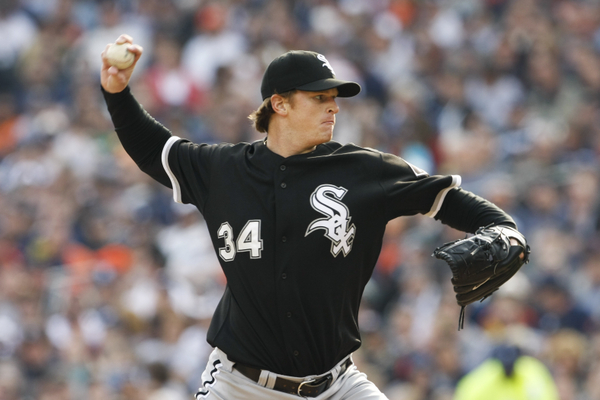
The last pitcher I'm thinking about is the least likely of the four, Gavin Floyd. I only selected him because of the General Manager of his team, the White Sox. Kenny Williams will trade anyone at anytime. He has emptied out his farm system in the past few years to get the players he feels the White Sox need to compete and succeed. I'm all in favor of trading prospects this offseason, but Kenny Williams takes it to the extreme.

One could make the argument that the Padres unexpectedly successful season is due to Kenny Williams. In July 2009, the Padres traded Jake Peavy to the White Sox for Clayton Richard and 3 other minor leaguers. Richard has been a dependable rotation staple for the Padres, while Peavy continued to be injury prone with a strange shoulder injury that has kept him out most of 2010. Trading Peavy's huge salary may have given the Padres the financial flexibility needed to keep Adrian Gonzalez, thus fueling this run for the postseason in 2010.

But getting back to Gavin Floyd....the White Sox are going to fall short again of the AL Central title this year. Perennially their payroll has hovered around the low $100M mark. Heading into 2011, the White Sox have salary committments of $75M already, with arb cases for Carlos Quentin and John Danks (plus whether or not to tender Bobby Jenks for maybe $10M) and a decision on free agent to be Paul Konerko. In short, the White Sox may be looking to retool and compete in 2011. Gavin Floyd's salary may help provide a little wiggle room for them.

Gavin Floyd, RHP -- age 28 in 2011 season
Contract details -- $5.0M in 2011, $7.0M in 2012, club option in 2013 for $9.5M

To date in 2010, Floyd has pitched 187 innings with a 7.20 K/9 rate, a 2.79 BB/9 rate, and has posted a 4.08 ERA and 3.48 FIP.

Floyd's arsenal includes a 92 mph fastball, 84 mph slider, 79 mph curve, and an 84 mph changeup. His slider has had the most positive results of runs saved per 100 pitches thrown.

As for the trade package, the White Sox in the draft are historically conservative. They favor the floor more than the ceiling so the Universal Trade Chip of Rudy Owens will work here. They are partial to toolsy outfielders, though, so Gorkys Hernandez may interest them. Diego Moreno with his live arm would fit nicely into their bullpen with Sergio Santos and Matt Thornton.

The Pirates need to upgrade the rotation and immediate help will not come from the farm before June 2011. Instead of hoping and wishing for the prospects to pan out, it's time for the Pirates to acquire known, successful commodities.

Wednesday, September 15, 2010

Offseason Trade Targets for Pitching (3 in a series) - Ricky Nolasco


Let's keep on trucking...we have already discussed James Shields and Scott Baker, so let's turn our attention to a slightly more volatile commodity in Ricky Nolasco.

The Marlins are always teetering on the edge of a fire sale, but last offseason's shot across the bow from the players' union about not properly spending revenue sharing forced them to raise payroll a little in 2010. The Marlins signed Josh Johnson to a big-money extension (4 yr - $39M through 2013) and already have Hanley Ramirez locked up through 2014. That's plenty of time for Hanley to keeping dogging it in the field and get a coach or two fired.

The Marlins are looking at $10M to keep Dan Uggla, if they tender him a contract of course. Once you add in their other committments and some estimated arb numbers and min wage numbers, you're looking at a $40M payroll without Nolasco, who will be entering arb-3 (he's a Super 2 so there will be an arb-4). Nolasco made $3.8M this year so a $5.8 to $6M contract in in the realm of possibility.

The other item to consider is that the Marlins farm system is drying up. A once fertile farm has started to go fallow, as Cameron Maybin and Andrew Miller have been busts. Kyle Skipworth showed some signs of life this year, but not enough. Chad James from 2009's draft had a great debut, but he is years away still. Mike Stanton and Logan Morrison made their debuts this year.

The Marlins could trade Nolasco, rebuild the farm and re-load on the fly for 2011.

Ricky Nolasco 6-2/230 RHP, age 28 in 2011 season

Contract: $3.8M in 2010, going into arb-3 in 2011

I referred to Nolasco as "volatile" in the opening paragraph because unlike Shields and Baker, Nolasco is inconsistent but with better overall stuff than those two.

Nolasco throws a 91 mph fastball, an 84 mph slider, a 75 mph curveball, and a 85 mph splitter. Historically, both his slider and curve have been reliable out pitches that are above the run line.

The Marlins like boom or bust prospects and pitchers with some heat. As a result, I'm not going to use the Universal Trade Chip known as Rudy Owens in this scenario. Rather, I will sacrifice Jeff Locke, Diego Moreno, and Robbie Grossman to the Marlins.

A few folks on some other forums feel that what I'm offering in these trades is not enough, not even close. Here's what the Angels gave up for Dan Haren (signed thru 2012, with a club option in 2013), with the approximate Pirate equivalent in parentheses:

Joe Saunders (Zach Duke)
Tyler Skaggs (ZVR)
Patrick Corbin (Jeff Locke)
Rafael Rodgriguez (Steven Jackson)

Considering that Rodriguez is a total throw-in, these packages of 3 minor leaguers that I'm offering are the equivalent (or better since Saunders/Duke suck and are expensive) to the Haren package.

Friday, May 14, 2010

Pirates Bullpen - the Meek shall inherit the closer's job

Is it strange that I am comforted once the Pirates' starter goes OUT of the game? Anyone else?
For all of the kvetching in the off-season about the Pirates (gasp) spending money on a portion of the team, the bullpen, it appears to have been a good investment.

Aside from an inning or two in a blowout game (yes...I know those count), Hanrahan and Dotel have been very solid, Hanrahan bordering on dominant. But one pitcher is not bordering on dominant, he IS dominant and that's Evan Meek.

Evan Meek was NH's first foray into the Rule 5 draft...the unwashed masses from another team's farm system....available to all in a draft order for a mere $50,000. His 2008, the season where you attempt to do everything you can to hide a Rule 5 guy including phantom trips to the DL, was atrocious.

2008 6.92 ERA/1.77 WHIP, 13 IP, 4.85 K/9, 8.31 BB/9, .231 BAA -- (91.2 mph FB)

He didn't trust his stuff. In 2009, he went to the minors and came back for an encore. It was very encouraging, a nice progression....

2009 3.45 ERA/1.34 WHIP, 47 IP, 8.04 K/9, 5.55 BB/9, .204 BAA -- (93.2 mph FB)

He improved and, hey maybe, he could be a nice setup guy one day. The walks were still a little troubling and his velocity was quite what it was made out to be pre-Rule 5. And then 2010 started....

2010 0.82 ERA/0.95 WHIP, 22 IP, 9.00 K/9, 2.45 BB/9, .195 BAA -- (94.7 mph FB)

The walks have been drastically cut down in his three seasons and his fastball has increased dramatically. Even better this year has been his curveball....Fangraphs has it as his best pitch, tracking at 4.77 wins above average for every 100 thrown. That's rarified air for a pitch. Consider that Tim Lincecum's changeup is the highest rated at 5.67 wins/100.

I love Meek, Hanrahan, Dotel as the 7th, 8th, 9th inning guys, but I would love to see the order reversed to Dotel, Hanrahan, and Meek by the end of the year. Perhaps in 2011, even if Dotel's option is picked up, that will be the case.

Wednesday, April 28, 2010

High School Pitchers vs. College Pitchers - 1st round from 2000-2005

Over at Only Bucs, there has been a lot of debate over who the Pirates should draft at 1-2 (assuming that Bryce Harper is off the board). My personal choice would be Jameson Taillon, a high school pitcher from Texas that gasses it at 98 mph. However, I feel that this front office is averse to drafting HS pitchers in the first and paying a large bonus to them (too many eggs in one basket).

As a result, due to the lack of both HS and college bats in this draft, I believe they will go with a college pitcher and select Drew Pomerantz.

One poster is adamantly opposed to drafting a college pitcher, not only in the 1-2 spot, but in the entire first round. He's even made it his signature below his posts...."Say no to college pitchers in the first round".

This got me thinking about the relative success/failure of recent 1st round picks among pitchers. For this post, I'm going from 2000 to 2005, as I believe 2006 is a shade too early to evaluate all the selections at this point. Some are either still at AAA or below or very early in their MLB careers.

Now success...that's very subjective....I don't think that Sean Burnett was a successful pick. You don't draft Burnett thinking "Here's our future LOOGY". But Chad Cordero, for instance, was a good pick. He was picked to be a closer and at least for a few years he did just that. Of course, this is subject to debate.

This post will be lengthy, so I'll "Executive Summary" it for those who want the bottom line. If you want to see how the sausage is made, keep reading after.

Executive Summary
2000-2005 Results
15 out of 59 College Pitchers were a "YES" (25.4%)
10 out of 33 High School Pitchers were a "YES" (30.3%)

Conclusion
While HS pitchers have been more successful, I feel that the margin between the two categories is small enough to NOT warrant such a reaction to swear off drafting COL pitchers entirely. Personally, I feel that HS pitchers have more "impact" potentially, due to more careful overseeing of pitch counts and the ability to be in the majors by age 22 versus age 24 for college guys.

However, if I liked a COL pitcher I would not feel the need to pass on him because of pre-disposed tendencies.

Number Crunching Results
2000
1-2 A. Johnson - MIN - No
1-4 M. Stodolka - KC - No [HS]
1-5 J. Wayne - MON - No
1-8 M. Wheatland - DET - No [HS]
1-9 M. Phillips - SD - No [HS]
1-10 J. Torres - LAA - No [HS]
1-14 B. Hale - BAL - No
1-16 B. Traber - NYM - No
1-17 B. Diggins - LAD - No
1-19 S. Burnett - PIT - No [HS]
1-20 C. Bootcheck - LAA - No
1-21 B. Bonser - SF - No [HS]
1-22 P. Dumatrait - BOS - No
1-24 B. Williams - SF - No
1-27 R. Stiehl - HOU - No
1-29 A. Wainwright - ATL - Yes
1/10 COL
0/6 HS
* M. Harrington did not sign

2001
1-2 M. Prior - CHI - Yes
1-3 D. Brazelton - TB - No
1-4 G. Floyd - PHI - Yes [HS]
1-6 J. Karp - MON - No
1-7 C. Smith - BAL - No
1-8 J. Van Benschoten - PIT - No
1-9 C. Griffin - KC - No [HS]
1-11 K. Baugh - DET - No
1-12 M. Jones - MIL - No [HS]
1-16 K. Honel - CHW - No [HS]
1-17 D. Denham - CLE - No [HS]
1-18 A. Heilman - NYM - No
1-21 B. Hennessey - SF - No
1-22 J. Bulger - ARI - No
1-24 M. McBride - ATL - No [HS]
1-26 J. Bonderman - OAK - Yes [HS]
1-27 A. Horne - CLE - No [HS]
1-28 J. Pope - STL - No
1-30 N. Lowry - SF - No
1/11 COL
2/8 HS
* J. Sowers did not sign

2002
1-1 B. Bullington - PIT - No
1-3 C. Gruler - CIN - No [HS]
1-4 A. Loewen - BAL - No [HS]
1-5 C. Everts - MON - No [HS]
1-6 Z. Greinke - KC - Yes [HS]
1-9 J. Francis - COL - Yes
1-12 J. Saunders - LAA - Yes
1-15 S. Kazmir - NYM - Yes [HS]
1-17 C. Hamels - PHI - Yes [HS]
1-18 R. Ring - CHW - No
1-21 B. Brownlie - CHI - No
1-22 J. Guthrie - CLE - Yes
1-24 J. Blanton - OAK - Yes
1-25 M. Cain - SF - Yes [HS]
1-29 D. Grigsby - HOU - No
1-30 B. Fritz - OAK - No
4/9 COL
4/7 HS

2003
1-3 K. Sleeth - DET - No
1-4 T. Stauffer - SD - No
1-8 P. Maholm - PIT - Yes
1-9 J. Danks - TEX - Yes [HS]
1-14 R. Wagner - CIN - No
1-16 J. Allison - FLA - No [HS]
1-20 C. Cordero - MON - Yes
1-22 D. Aardsma - SF - No
1-24 C. Billingsley - LAD - Yes [HS]
1-25 B. Sullivan - OAK - No
2/7 COL
2/3 HS

2004
1-2 J. Verlander - DET - Yes
1-3 P. Humber - NYM - No
1-4 J. Niemann - TB - Yes
1-5 M. Rogers - MIL - No [HS]
1-6 J. Sowers - CLE - No
1-7 H. Bailey - CIN - No [HS]
1-10 T. Diamond - TEX - No
1-12 J. Weaver - LAA - Yes
1-13 B. Bray - MON - No
1-16 D. Purcey - TOR - No
1-17 S. Elbert - LAD - No [HS]
1-19 C. Lambert - STL - No
1-22 G. Perkins - MIN - Yes
1-23 P. Hughes - NYY - Yes [HS]
1-25 K. Waldrop - MIN - No [HS]
1-27 T. Tankersley - FLA - No
1-29 M. Campbell - KC - No
1-30 E. Hurley - TEX - No [HS]
4/12 COL
1/6 HS
* W. Townsend did not sign

2005
1-6 R. Romero - TOR - Yes
1-8 W. Townsend - TB - No
1-9 M. Pelfrey - NYM - Yes
1-15 L. Broadway - CWS - No
1-16 C. Volstad - FLA - Yes [HS]
1-18 C. Carillo - SD - No
1-20 M. Pawelek - CHI - No [HS]
1-22 A. Thompson - FLA - No [HS]
1-24 B. Bogusevic - HOU - No
1-25 M. Garza - MIN - Yes
1-26 C. Hansen - BOS - No
1-27 J. Devine - ATL - No
1-29 J. Marceaux - FLA - No
3/10 COL
1/3 HS

Thursday, December 10, 2009

What is a #2, #3, #4, #5 pitcher?

Last post, I took a look at some criteria for what constituted an ace or a #1 pitcher. The list was very small, only 5 current pitchers. During the research, by my personal criteria for a #2, I determined that there was a huge number of #2's in the league (or "almost-aces"). Here's my personal criteria for a #2:
-- between 180 to 200 innings consistently
-- less than 9 Hits/ 9 IP
-- between 7.5 K and 9 K/ 9 IP
-- less than 3.5 BB/ 9 IP
-- ERA under 3.50
As I said before, I would rather have two #2's instead of one #1's and a bunch of junk. Two #2's (or "almost-aces") spread your risk out a little more and can provide fits if both pitching in the same series. If one is a righty and one is a lefty, that's just icing on the cake.

Here's who I determined are #2's....
CC Sabathia (K level has been dropping over the past few years)
Burnett
Beckett
Javier Vasquez
Shields
Garza
Halladay (he's extremely durable, but has never been a strikeout pitcher)
Danks
Lee
Lackey
Jared Weaver
King Felix (K rate)
Josh Johnson
Santana
Carpenter
Zambrano
Wandy Rodriguez
Cain

So that's 18 #2's, with a couple of guys to keep an eye on (Scherzer, Edwin Jackson -- ironically traded for each other) for 2010.

Let me run the basics for the other 3 rotation spots and give a Pirates-related example:
DBS Criteria for a #3 pitcher
-- 170 to 180 IP
-- 8.5 to 9 Hits/ 9 IP
-- 6.5 to 7.5 K/ 9 IP
-- 3.5 BB/ 9 IP or less
-- 3.50 to 4.00 ERA
Paul Maholm is pretty much a text book #3

DBS Criteria for a #4 pitcher
-- 160 to 175 IP
-- more than 9 Hits/ 9 IP
-- 6 to 7 K/ 9 IP
-- greater than 3.5 BB/ 9 IP
-- 4 to 4.50 ERA
Basically control is what separates a #4 from a #3, as these guys usually only have 2 pitches with an average 3rd or watch their control escape them on a given night. Charlie Morton last year was a #4

DBS Criteria for a #5 pitcher
-- 150 IP to 165 IP
-- more than 9 Hits/ 9 IP
-- less than 6 K/ 9 IP
-- greater than 4 BB/ 9 IP
-- 4.75 or greater ERA
A number 5 is a guy without a true go-to strikeout pitch, usually doesn't have above-average velocity and may only have 2 pitches. These guys can be valuable if they are slightly better than the opposition's #5, but for the most part these guys are 1 start away from going to the pen.
Jeff Karstens last year was, at best, a #5.

Hopefully this helps next time you hear someone at a bar refer to Zach Duke or Paul Maholm as our "ace". I'll be the guy sitting next to him with an uncontrollable facial tick when he says that.

Wednesday, December 9, 2009

What is an Ace?

You hear it all the time..."The Pirates need an Ace pitcher" or "The Pirates need a true #1 pitcher, go get one Nutting and Neil".

Unfortunately, Ace Hardware does not sell Ace Pitchers. I checked.

The term "ace" is greatly abused and misunderstood by the mainstream media and even fans. You hear it when watching the games on FSN all the time that the Pirates are sending "their ace, Paul Maholm" against the opposing team's pitcher.

Fans all the time love to toss comps on players saying a draft pick can be a future #1 or #2, or that Pitcher X can become a #3 or this guy isn't any good, he'll just be a #5.

So I thought I would like to share my thoughts on what is an ace (a #1) and what I feel the classifications are for #2 through #5 pitchers.

Let's start at the top with an Ace (#1 pitcher). Here's some criteria that I have gleaned from various sources and my own statistical observations:
-- must pitch 200+ IP/year consistently
-- have a K rate greater than 9 per 9 IP
-- have a BB rate less than 3 per 9 IP
-- allow less than 9 hits per 9 IP
-- have a sub 3.00 ERA (yes, I know that ERA is not the best way anymore)

So who are today's Aces? It's a very exclusive group:
Jon Lester, Justin Verlander, Zack Grienke, Tim Lincecum, Dan Haren
That's it.

Noticeable by their absence are some big names that many commonly refer to as aces, but I don't feel meet the true criteria. CC Sabathia's K rate has dropped in recent years, Roy Halladay was never a strikeout pitcher instead relying on the best sinker in the game, Josh Beckett's K rate is dropping, Cliff Lee has never been a huge strikeout guy, Johan Santana is losing steam, and Felix Hernandez has never had more K's than IP.

All of these guys are #2's. That doesn't mean that with 1 game on the line I wouldn't ask ANY of those guys above to take the mound. I'm just saying that they are misclassified as #1's. And frankly, I would rather have two #2's than one #1 and a bunch of junk around him.

There are some young pitchers in the game who have the capability to be #1's in the very near future, as soon as 2010 actually. Guys to keep an eye on are:
Tommy Hanson
Neftali Feliz - if he starts full time
Stephen Strasburg
Chad Billingsley
Ubaldo Jimenez
Yovani Gallardo
Clayton Kershaw
Both Gallardo and Kershaw need to control their BB rate a little more and increase their IP into the 200 range.

Next post I'll detail what is a #2, #3, #4, and #5 pitcher.