Recently, I got into the English Premier League (let's go Liverpool and Steven Gerard!) and was stunned to realize that there were teams more valuable than the vaunted New York Yankees. Seriously, I don't know if that my narrow-minded Americanism shining through, but by all accounts Manchester United in the EPL and Real Madrid in la Liga are more valuable of franchises than the Yanks.
As I've researched the EPL more, I've been struck by the net worth of some of the owners. I've known for a while that the Glazer family owned Manchester United, but did not know that John Henry and the Fenway Group own Liverpool. Stan Kroenke (of the Denver Nuggets and Colorado Avalanche) is the majority owner of Arsenal. So arguably the top 3 franchises in the EPL are owned by Americans, which has to honk the Brits off to no end. Additionally, three other teams (Aston Villa, Sunderland, and Fulham) are primarily owned by Americans.
But take a look at some of the other owners. There's a sheik worth $20 BILLION that bought Manchester City recently as a plaything. Roman Abramovich (owner of the Brooklyn Nets) is worth $10 Bills, too.
These teams are the crown jewel of the sporting world with worldwide appeal. They're treated as status symbols for these owners.
But what if they get tired of owning a sports team? What if these billionaires want to expand their power base and buy a whole city?
Things would have to change dramatically, especially in the United States, to allow the general citizenry to accept having their government effectively taken over by a hostile takeover. But at this point with Detroit, who would really object if someone like Bill Gates came in and purchased the city out of (essentially) a bankruptcy sale?
A proven CEO would be able to eliminate the unwanted chaff, sell off the appropriate assets, and figure out the best economical course of action to bring a struggling city out of the red, just like any other business. There would be drastic, sweeping changes, which would probably affect the retirement benefits of workers. This would be an issue.
As far as the United States goes, the threat of a benevolent dictator owning a city would not be appealing in the year 2013. But if Detroit is only the first major city in the next two decades to go third-world, the general public may change their minds. In countries where democracy is not so prevalent, the billionaire owner could be a smoother entry.
It wouldn't be a Communist country like China or a strong democratic country like Britain. Maybe Russia would be a good test model, as they have a lot of cities that suck and seems generally lawless. Putin strikes me as the guy who will allow anything as long as he gets a cut, so maybe another Russian billionaire could propose this venture.
Just imagine the year 2090 and watching the Ford Hovercar Detroit Tigers play the Facebook San Francisco Giants play a game of quaint old baseball. Will we long for the days of corrupt politicians that we can at least try and vote out periodically?
Showing posts with label Cities. Show all posts
Showing posts with label Cities. Show all posts
Thursday, October 24, 2013

Friday, September 20, 2013
How the City of Detroit can learn from the Houston Astros

No, not the Detroit Tigers.
I mean the actual city of Detroit. Bear with me for a second.
For years, the Houston Astros refused to rebuild, even when faced with the specter of fading franchise icons like Jeff Bagwell, Craig Biggio, Roy Oswalt, and Lance Berkman. Their owner, Drayton McLane, refused to face the inevitable and instead through bad money after good. At McLane's direction, the entry draft was overlooked and draft picks wasted. Prospects were traded away for any stopgap to help try and keep the Astros afloat.
In 2011, McLane finally sold the team to Jim Crane, who brought in Jeff Luhnow from the Cardinals to be his General Manager. The edict came down swiftly from the top:
Tear it down and start all over.
Luhnow took those words to heart and then some. Not only did he tear the figurative building down, he tore out the foundation, set fire to the property, and then is building from the ashes. Here's the Opening Day payrolls for the Astros over the last 5 years:
2009 -- $102M
2010 -- $92M
2011 -- $76M
2012 -- $60M
2013 -- $26M
That payroll has dropped even more through the course of this year, as Bud Norris, Jose Veras, and some others have been shed. No player on the Astros' current roster makes more than Erik Bedard's $1.1M. Their payroll is approximately $14M of active players, with the Pirates' Wandy Rodriguez adding $5M on to that (plus $5.5M in 2014).
But all of these trades have yielded a passel of interesting prospects in return. Additionally, the Astros have fully utilized their draft budgets to the fullest extent in recent years. Their farm system is widely considered to be a Top 3 farm system with a great potential rotation in the minors, coupled with some recent farm graduates like Jarred Cosart and Brett Oberholtzer. And they get to potentially draft a potential ace in Carlos Rodon next June.
So what does this have to with Detroit?
Instead of trying to hang on and make it work with patches here and there, the City of Detroit must be allowed to be torn down and start over. The statistics are frightening:
40% of street lights are either off or not functional, so that Detroit doesn't have to pay for electricity
Buses may have wait times of 2 hours or more
911 calls are hardly ever answered on time
The population lost 200,000 people from 2000 to 2010
The city has a long term debt of $18 to $20 BILLION
Efforts are underway to shrink the city's footprint by demolishing vacant homes and turning them into green space, but these are only half measures. There need to be a commitment to relocating and then demolishing entire neighborhoods and sectors of the city.
Shrink the city to a manageable size so that the police force (shrunk from 4,000 to 2,600 officers) can safely patrol it. So that emergency providers can do their jobs efficiently. Detroit needs to find an alternate industry, besides the auto industry, to build with. Perhaps something in the green energy industry to take advantage of the abandoned manufacturing areas and workers skilled in manufacturing.
Once the city is condensed down to a population-dense size, start to rebuild new mixed income housing to attract the youth back to the city, but also give quality housing to the elderly and poor that need it. Re-invest in the education system (a comparison to the Astros and the draft) and realize that the City of Detroit is not going to be great again for 20 years.
If Detroit (and the state of Michigan) can understand these things and commit to them, the rebuilding process can start in full. That won't help things in 2013, but it give Detroit hope in 2033 that it will be a great city again.
Or else it will look just like the Robocop movies.
Tuesday, September 10, 2013
Cuidad Valdeluz, Spanish Ghost Town

If you're like me, you have thought of Spain as a decently well-put together country. Fun party areas, cool cities like Madrid and Barcelona, good weather. Unfortunately, the worldwide recession has hit Spain particularly hard. It's one of the "PIGS" (Portugal, Ireland, Greece, Spain) that are dragging the European Union down economically.
Spain's unemployment rate stands around 26.9% (May 2013 rate), which is....atrocious. So needless to say, some stuff is tore up in Spain.
My brother-in-law told me about an episode of Top Gear he saw on BBC America where the guys went to a Spanish ghost town called Cuidad Valdeluz. The Top Gear were able to squat in half built or completely built housing units that were never filled as a result of the economy going pear-shaped in 2008.
Cuidad Valdeluz was intended to one of many satellite cities built around Madrid and served by high-speed rail to the main metro area. It was built out for 30,000 people. Today, around 3,000 people live there. There's no grocery store and very few amenities for the people. There are construction cranes sitting idle for years at half-built apartment buildings. The roadway network and utilities are fully built, but just...sitting there. There are huge tracts of undeveloped land still.
It's described as looking like an abandoned movie set. Will it be populated once Spain's economy improves? Maybe, but when will that be? I can't see an economy like Spain's rebounding for at least 5 years. Could you live in eerie isolation like that? With hoodlums roaming around ripping copper and anything else out of buildings for scrap money?
In the United States, there are plenty of housing developments (large and small) that are vastly underpopulated or abandoned. But not whole towns built for 30,000 people. Viva la Spain!
Monday, December 12, 2011
Will they elect a fake City Council, too?

Here we sit at the tail end of 2011, with large masses of people around the country upside down on their mortgages, or worse...homeless, living in their cars or the streets. And what does one company, Pegasus Holdings, propose to do?
Build a ghost town from scratch in the desert expanse of New Mexico. Seriously. If they want to utilize a ghost town, what's wrong with Detroit? Snark.
Pegasus is proposing to construct the Center for Innovation, Testing, and Evaluation (CIT-E, get it?) in order to implement different energy-saving technologies in building and streets and then field test their performances. They may bring in some human test subjects from time to time to groundtruth the mechanisms, but for the most part the only humans will be confined in underground laboratories watching every quirk and nuance of these different experiments, ranging from surveillance to power grids to smart streets to security systems.
And this won't be some 10 city block testing lab. It will 20 square miles, consisting of an urban core, suburbs, and outlying rural areas. The infrastructure (water, sewer, electric, cable, gas) will be laid out to accomodate a potential 30,000 person population.
Coupled with PlanIT that I wrote about, the egghead community sure seemed to play as much SimCity2000 as I did growing up. But then my 2nd-tier thinking/conspiracy theorist starts kicking in....
By locating in New Mexico's deserts near Las Cruces, rife with energy and defense contractors, I highly doubt that CIT-E will be only for energy and traffic experiments. I have a feeling that the military will be field testing tactical weapons shortly after this opens -- to see how a city block reacts to different cutting edge technologies dreamed up by DARPA.
Just as long as the government powers-that-be don't set up their own Science City Zero, we should be OK, I suppose.
Thursday, April 21, 2011
PlanIT Valley - Bring on the Arcologies

When I was a young nerd in my early 20's, fresh out of college with an engineering degree, I became addicted to Sim City 2000. It was a computer game in which you were given a empty canvas with terrain and were able to build a city from the ground up. Roads, power lines, water pipes, power plants, the whole nine yards. You designated what areas were zoned residential, commercial, and industrial and the appropriate types of structures to build. You needed to account for the proper amount of schools, police departments, and fire departments.

In short, you were god of this little city and could watch it grow before your very eyes, as long as you kept things running smoothly. The citizenry could riot against you, cause fires, floods may occur, even an alien invasion if you were so inclined.
I guess Sim City 2000 was popular in Portugal in the late 90's, too, because outside of Parades, Portugal is growing an eco-city called PlanIT Valley. The city in its built-out state will serve 225,000 people in an array of eco-friendly buildings that are embedded with a host of sensors to monitor environmental conditions and adjust accordingly. The green building techniques and the energies that will power this city will make PlanIT Valley a zero carbon footprint community...a completely green city.
All this for the low, low price of $10 billion dollars, while the world is in the midst of the biggest worldwide recession in decades. However, PlanIT Valley has some backers already in the form of Microsoft and Cisco, with Microsoft reportedly putting $300M into the kitty.
The city will be a testing lab for the integration of information technology, urban planning, and construction. I'm not sure if I could handle the sensation of feeling like a lab rat being studied by someone remotely as I went about my daily business. In order to put 225,000 people on 4,000 acres, along with all of the necessary functions like schools/police/fire departments/etc, PlanIT Valley will be a densely built environment.
This reminds me of when your city matures in Sim City 2000 to the point that arcologies are introduced. Arcologies (a combination of architecture and ecology) were a city-within-a-city in the game. They were a way for you to fit 20,000 people into a small area by building vertically and containing functions within that arcology. Most of the arcologies available were benign and pleasant, but there was one that was dark and forboding. It did not have a lot of natural light and it affected your citizens. They almost became a sub-set of humans, it was said.
Reports are circulating that the world's population is expected to double from 6 billion to 12 billion in the next 30 years. That's unfathomable to me. It seems that some glass ceiling will be hit long before that happens. The Earth can simply not support that many people. As it stands now, there are vast tracts of land unable to grow food and clean water is scarce. How are we going to jam 6 billion more onto this little blue marble and have any semblance of life? I'm not even talking about the United States. Look at some of the cities in India and China...that's not exactly the model of good urban living over there. It will be primarily that part of the world experiencing the bulk of the population increase, too.
I watch and enjoy a lot of movies that have dystopian, post-apocalyptic futures. I fear that these escapes from reality are primers for what we are moving towards at a breakneck pace.
I'm not sure if PlanIT Valley is something to be admired for its vision or feared for it's depressing look into what our future may become. A race of people jammed into cities-within-cities like files in a filing cabinet. Unable to breathe the air, drink the water, or have more than a 10 foot radius of personal space.
Tuesday, December 7, 2010
Amoeba Cities
A megalopolis is defined as a cluster of cities and their metropolitan regions that have 10 million or more people in it. Ground transportation links such as railroads and highway interconnect these cities and commute their commerce. I was surprised to learn that the United States has 13 megalopolises (or megaregions) within its borders or extending in some cases into Canada and Mexico.
Even more surprising is that Pittsburgh is part of the largest megalopolis in North America -- the Great Lakes Megalopolis. The Great Lakes Megalopolis is comprised of:
Chicago
Toronto
Detroit
Pittsburgh
Milwaukee
St. Louis
Minneapolis
Ottawa
Indianapolis
Kansas City
Cleveland
Cincinnati
Dayton
Columbus
Grand Rapids
Toledo
Akron
Buffalo
Rochester
Whew! All told these regions had a 2000 census population of 53.8 million people, with a projected 2025 population of 63.7 million.
Now...I don't know about you, but I don't feel any kinship with my brethern in, say, Grand Rapids. Couldn't tell you much about Milwaukee and have no bond with Dayton. I've been to Akron and it really sucks as a city.
I'm wondering if in our current lifetimes we will ever see two cities actually expand towards each other, like amoebas blindly flailing away in the primordial ooze. Our closest major urban neighbor is Cleveland, which I have been to twice this year already. It has its share of problems, both financial and social, but it has promise as well. Cleveland is virtually Pittsburgh's sister city as it is.
The technology that will foster the amoeba city migration is high-speed rail. Currently it takes a shade over 2 hours and 15 minutes to drive from downtown Pittsburgh to downtown Cleveland (traffic not withstanding). That's at a cruising speed of 75 mph. What if you could get there in half the time on a dedicated high-speed rail line? What would that do for business? Imagine getting up at your usual wake-up time and going to Cleveland for a 9 am meeting. Heck, what would that do for pleasure? A Clevelander could dine at Salt of the Earth at 7 pm and still be comfortably back by the 10 pm news. A Pittsburgh could enjoy Lola and then sit back and be swept back home at 160 mph.
Our world is simply getting smaller. Information is available instantly at our fingertips now. We can Skype in with people anywhere in the world. Sadly, our businesses know no bounds -- products are made and sold everywhere in the world. But our transportation network, at least in the United States, is still modeled from the 1960's gas guzzling era.
High-speed rail came into the national discussion recently when these two forward thinking governor-elects, from Ohio and Wisconsin, turned down $1.2 BILLION dollars to construct high-speed rail lines in their states. These weren't planning studies, either. These were funds to construct high-speed rail linkages between the major cities in these states. Ohio turned down $400 million to link Cleveland, Cincinnati, and Columbus. Wisconsin rejected $810 million to link Madison and Milwaukee. Both were concerned that the operating and maintenance costs would outweigh the revenue received.
While that's valid, it's also short-sighted. Companies and residents alike would flock to the opportunity to have that much freedom to move goods and be transported. It would be a model for the rest of the United States, especially in this era when everyone is trying to prove how green they are compared to the next guy. High-speed rail is king in Europe, where gas prices are nearly double what they are here. But therein lies the problem...we are a nation suckling at the teat of the oil industry, both domestic and foreign sources. Until we wake up and realize what we're doing, we'll never see what we are missing.
Even more surprising is that Pittsburgh is part of the largest megalopolis in North America -- the Great Lakes Megalopolis. The Great Lakes Megalopolis is comprised of:
Chicago
Toronto
Detroit
Pittsburgh
Milwaukee
St. Louis
Minneapolis
Ottawa
Indianapolis
Kansas City
Cleveland
Cincinnati
Dayton
Columbus
Grand Rapids
Toledo
Akron
Buffalo
Rochester
Whew! All told these regions had a 2000 census population of 53.8 million people, with a projected 2025 population of 63.7 million.
Now...I don't know about you, but I don't feel any kinship with my brethern in, say, Grand Rapids. Couldn't tell you much about Milwaukee and have no bond with Dayton. I've been to Akron and it really sucks as a city.
I'm wondering if in our current lifetimes we will ever see two cities actually expand towards each other, like amoebas blindly flailing away in the primordial ooze. Our closest major urban neighbor is Cleveland, which I have been to twice this year already. It has its share of problems, both financial and social, but it has promise as well. Cleveland is virtually Pittsburgh's sister city as it is.
The technology that will foster the amoeba city migration is high-speed rail. Currently it takes a shade over 2 hours and 15 minutes to drive from downtown Pittsburgh to downtown Cleveland (traffic not withstanding). That's at a cruising speed of 75 mph. What if you could get there in half the time on a dedicated high-speed rail line? What would that do for business? Imagine getting up at your usual wake-up time and going to Cleveland for a 9 am meeting. Heck, what would that do for pleasure? A Clevelander could dine at Salt of the Earth at 7 pm and still be comfortably back by the 10 pm news. A Pittsburgh could enjoy Lola and then sit back and be swept back home at 160 mph.
Our world is simply getting smaller. Information is available instantly at our fingertips now. We can Skype in with people anywhere in the world. Sadly, our businesses know no bounds -- products are made and sold everywhere in the world. But our transportation network, at least in the United States, is still modeled from the 1960's gas guzzling era.
High-speed rail came into the national discussion recently when these two forward thinking governor-elects, from Ohio and Wisconsin, turned down $1.2 BILLION dollars to construct high-speed rail lines in their states. These weren't planning studies, either. These were funds to construct high-speed rail linkages between the major cities in these states. Ohio turned down $400 million to link Cleveland, Cincinnati, and Columbus. Wisconsin rejected $810 million to link Madison and Milwaukee. Both were concerned that the operating and maintenance costs would outweigh the revenue received.
While that's valid, it's also short-sighted. Companies and residents alike would flock to the opportunity to have that much freedom to move goods and be transported. It would be a model for the rest of the United States, especially in this era when everyone is trying to prove how green they are compared to the next guy. High-speed rail is king in Europe, where gas prices are nearly double what they are here. But therein lies the problem...we are a nation suckling at the teat of the oil industry, both domestic and foreign sources. Until we wake up and realize what we're doing, we'll never see what we are missing.
Thursday, October 28, 2010
Public Record - peeling back the layers of Pittsburgh's history
The Post-Gazette had an article on Wednesday about a multi-media project called Public Record. It's a book, art exhibition, poetry reading, and iPhone application. It's meant to give us a glimpse back to a time when Pittsburgh was very rough around the edges. A time when it was, if not socially acceptable, at least well overlooked to kill an Irish immigrant that stepped out of line. A time when gambling halls were on every block. It was during this time that current-Point State Park was a massive tenement area.
Some point in the near future, DB~ and I will download the Public Record app and go around town listening to all the oral histories and poetic readings. But it got me thinking about Pittsburgh specifically and cities in general.
When we walk around town on the streets, we may as well be floating above the street. What history is buried 6 inches, 2 feet, 10 feet, or 20 feet below our feet? Who walked on the same street 5 days ago, 5 years, 50 years, 200 years ago? All of the buildings downtown, whether they are an abandoned warehouse in the Strip, a row house in the Hill District, or a non-descript building in the Golden Triangle have a story about previous tenants. Perhaps a misdeed like an unsolved murder of a prostitute or a robbery of a Mob boss.
I found myself walking around the edges of the Strip District tonight. Just feeling the city under my feet as the crisp October air propelled me forward. It was one of those nights that the neon from the Greyhound bus garage cut right through the air. There were pockets of activity, a packed house at Seviche, a handful of people in the dirty old man bars along Penn between the Convention Center and the Strip, a few tables occupied at Sushi Kim, a massive high-faluting event at the Heinz History Center. After I got back in my car, I drove over the recently re-opened Stanwix Street and was looking straight into PNC Park, with that clean pale blue neon staring right back at me.
Is our history recording better or worse nowadays than it was in the 19th century? We have video, Internet, digital camera, and the written word to document our history, but our society is a disposable one. When we're done with a building after only 30 years, we just smash it down and build over top of it. Are we tracking ourselves better or worse now? History is because people have poor memories that fade or misconstrue events over time.
Will someone be walking on top of our memories, misdeeds, and miscreants 100 years from now wondering about us?
Some point in the near future, DB~ and I will download the Public Record app and go around town listening to all the oral histories and poetic readings. But it got me thinking about Pittsburgh specifically and cities in general.
When we walk around town on the streets, we may as well be floating above the street. What history is buried 6 inches, 2 feet, 10 feet, or 20 feet below our feet? Who walked on the same street 5 days ago, 5 years, 50 years, 200 years ago? All of the buildings downtown, whether they are an abandoned warehouse in the Strip, a row house in the Hill District, or a non-descript building in the Golden Triangle have a story about previous tenants. Perhaps a misdeed like an unsolved murder of a prostitute or a robbery of a Mob boss.
I found myself walking around the edges of the Strip District tonight. Just feeling the city under my feet as the crisp October air propelled me forward. It was one of those nights that the neon from the Greyhound bus garage cut right through the air. There were pockets of activity, a packed house at Seviche, a handful of people in the dirty old man bars along Penn between the Convention Center and the Strip, a few tables occupied at Sushi Kim, a massive high-faluting event at the Heinz History Center. After I got back in my car, I drove over the recently re-opened Stanwix Street and was looking straight into PNC Park, with that clean pale blue neon staring right back at me.
Is our history recording better or worse nowadays than it was in the 19th century? We have video, Internet, digital camera, and the written word to document our history, but our society is a disposable one. When we're done with a building after only 30 years, we just smash it down and build over top of it. Are we tracking ourselves better or worse now? History is because people have poor memories that fade or misconstrue events over time.
Will someone be walking on top of our memories, misdeeds, and miscreants 100 years from now wondering about us?
Wednesday, August 4, 2010
Hell is round the corner, hot like a sauna
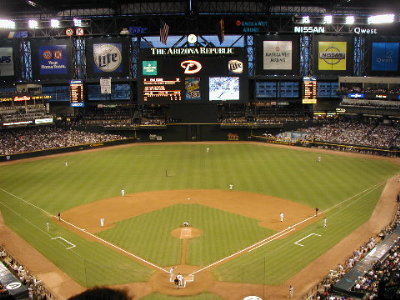
One of the few places I have not written about yet is Phoenix.
Phoenix is not for everyone. It's hot. All the time. There's not a lot of greenery. There is a lot of brownery and sandery.
But Phoenix, and the whole Southwest in general, gives you a feeling of wanting to explore and a feeling of wanting to just get in a car and drive. Yes, Phoenix is a major city and it has its share of traffic problems, but in very little time you can be out in the desert and it will be just, 500 cactuses, and miles of road ahead of you. In a way, it's peaceful.
Enough touchy-feely stuff. Let's talk places and food. That's what this blog is about right?
The last time I was in Phoenix was 2004 in October. To be specific, I actually stayed in Scottsdale, a suburb of Phoenix that within 25 years will just be absorbed into the metropolis of Phoenix probably. It was a cool 90 degrees the first weekend of that month. While there, I asked a shop owner, "What do you do in the summer when it's 110 degrees?" He said, "Well...you leave your air conditioned house, get in your air conditioned car, go to your air conditioned job and then at the end of the day, you do all that in reverse. And maybe, at 11 pm, you can get in your pool when it's 90 degrees outside."
I went to the last Diamondbacks game of the year, which was the year that the D-Backs went something like 51-111. But there were a lot of people at Bank One Ballpark (now it is Chase Field) that day. One of the people along the 3rd base line, sitting across the aisle from me, was a real culture vulture that had a tattoo of a naked lady (absolutely anatomically accurate) running up his entire leg from ankle to knee. It was a sight to behold. If I had my phone that I have today back then in 2004, that picture would be up here. I can't imagine how someone could go out in public, around all kinds of kids, and think that's a good idea.
Bank One Ballpark/Chase Field kind of sucks. First, unbeknownst to me, on any hot sunny day apparently they close the roof. I was all lathered up with sunscreen and felt like a dolt with the roof closed. Second, with the roof closed the ballpark kind of looks like a giant airplane hangar. I was looking around for the Spruce Goose or a stray dirigible. Third, the pool in RF is trashy. Any party of people can rent it and on this day a group of kids were using it as their personal bathtub.
Phoenix is not for everyone. It's hot. All the time. There's not a lot of greenery. There is a lot of brownery and sandery.
But Phoenix, and the whole Southwest in general, gives you a feeling of wanting to explore and a feeling of wanting to just get in a car and drive. Yes, Phoenix is a major city and it has its share of traffic problems, but in very little time you can be out in the desert and it will be just, 500 cactuses, and miles of road ahead of you. In a way, it's peaceful.
Enough touchy-feely stuff. Let's talk places and food. That's what this blog is about right?
The last time I was in Phoenix was 2004 in October. To be specific, I actually stayed in Scottsdale, a suburb of Phoenix that within 25 years will just be absorbed into the metropolis of Phoenix probably. It was a cool 90 degrees the first weekend of that month. While there, I asked a shop owner, "What do you do in the summer when it's 110 degrees?" He said, "Well...you leave your air conditioned house, get in your air conditioned car, go to your air conditioned job and then at the end of the day, you do all that in reverse. And maybe, at 11 pm, you can get in your pool when it's 90 degrees outside."
I went to the last Diamondbacks game of the year, which was the year that the D-Backs went something like 51-111. But there were a lot of people at Bank One Ballpark (now it is Chase Field) that day. One of the people along the 3rd base line, sitting across the aisle from me, was a real culture vulture that had a tattoo of a naked lady (absolutely anatomically accurate) running up his entire leg from ankle to knee. It was a sight to behold. If I had my phone that I have today back then in 2004, that picture would be up here. I can't imagine how someone could go out in public, around all kinds of kids, and think that's a good idea.
Bank One Ballpark/Chase Field kind of sucks. First, unbeknownst to me, on any hot sunny day apparently they close the roof. I was all lathered up with sunscreen and felt like a dolt with the roof closed. Second, with the roof closed the ballpark kind of looks like a giant airplane hangar. I was looking around for the Spruce Goose or a stray dirigible. Third, the pool in RF is trashy. Any party of people can rent it and on this day a group of kids were using it as their personal bathtub.
I ate at some great places, but the one I wanted to highlight was Pinnacle Peak's. It's an old fashioned cowboy BBQ place waaaayyyy outside of town. I think they semi-delight in being difficult to find. The steaks are not like at Morton's or Hyde Park....they're chewy and slightly overcooked, just like the cowboys probably liked them. The sides are baked beans, potatoes, and vegetables. Nothing fancy. If you wear a tie, they cut it off and hang it on the ceiling, which has led to people wearing all sorts of ugly ties on purpose.
If you're into architecture like I am, Frank Lloyd Wright's Taliesin West is outside Phoenix. It was his home near the end of his life where he escaped to recharge himself. It is now home to one of his academies of architecture.
There is plenty to do in Phoenix and the surrounding area. It is just a totally different mindset than what we are used to on the East Coast, that's all.
PS -- We're going to Deep Creek, MD this weekend and one of the things we're doing is going to be whitewater rafting at Wisp. If I survive, that will be the next blog post. Good Luck, DBS and DB~!
Wednesday, March 17, 2010
Re-imagining Pittsburgh (Part 1)
And now for Part 1 of an infrequent and open-ended series that I would like to call:
Pittsburgh in a Perfect World
I love the city of Pittsburgh. I love cities in general, but Pittsburgh in particular. The downtown is walkable and safe. Pittsburgh is full of interesting neighborhoods like the Strip District, South Side, Shadyside, Bloomfield, and Oakland, to name just a few.
But it has its quirks. Hey, don't we all.
If you had the chance to change something about Pittsburgh...like waving a magic wand over the city...what would you do? That's what I would like this post and subsequent ones (and your comments) to focus on.
For this first post, I wanted to discuss my thoughts about transportation in and around the city...
Make an Light Rail System out to the North Hills
I always used to refer to the HOV lane of I-279 as the "HIV" lane...It's there, but nobody wants it.
If this financial boondoggle of a multi-modal transportation center is going to be shoved down our throats on the North Side (complete with our own tunnel!), let's put it to good use. The HOV lane is criminally under-used, so let's re-purpose it to good use by making it a Light Rail line out not only to its current terminus, but extending it out to the intersection with I-79.
It would have limited stops along the way, perhaps only 3 or 4 at the key population nodes: McKnight Road, Camp Horne Road, and Wexford (and North Shore of course). The North Hills is already the easiest direction to travel into the city, but imagine the usage a Light Rail would get in the North.
Dissolve the Port Authority and make it a privately-owned entity
I'm not exacting breaking new ground here, but it needs to be said. There are many facets of why the Port Authority does not work, but the bottom line is that it is a beached whale. A large part of the problem is the current union structure, the pension problem, and insurance costs.
Port Authority needs to be torn down and started over. This time, make it a privately run enterprise with either a more favorable union contract or a non-union entity. It needs to be sleeker, more efficient, less stops and perhaps less routes. It should encourage more park and rides in the suburbs to concentrate pickups. It should work with planning departments to create more walkable neighborhoods in the city for urban users.
I would even like to see the new Port Authority explore water transit. Some entreprenuers are giving it a go in the Strip District during summer time months, but get serious about it with decent sized, powerful boats. There are plenty of marinas that would probably love a little extra revenue by acting as a daytime park and ride facility.
Make all planning and land development be completed at a county-wide level
There are too many municipalities in Allegheny County. Again, no surprise to many, but that will be a subject for Re-imagining Pittsburgh Part 2 probably.
However, not even discussing municipal consolidation, I'm proposing that we handle land development and land use on a county-wide basis. It can eliminate the urban sprawl and "me-first, gimme-gimme" attitude that suburbs have right now. Everyone is grasping to find tax revenues to keep their municipalities afloat, so they will develop any piece of land no matter how detrimental it may be to the greater region around them.
Case in point: Pittsburgh Mills in Frazer.
When it was proposed, it was going to be a regional mall that would attract a wide range of shoppers because of its unique-to-the-region stores. To that end, millions of taxpayer dollars were committed to adding new lanes to Route 28, new on and off-ramps at the mall's entrance points. Multiple acres of prime wetland, vital to the recharge and filtering of pollutants, were destroyed in the process.
The end result? A white elephant of a mall that was Dead on Arrival. The developer went bankrupt right before the mall opened. The unique stores proposed did not come. Today it is just another homogenous suburban mall, with the same restaurants and stores that you can find anywhere in the Pittburgh region.
Why was it a bad idea from the start? If you want to build a regional mall, you need to have a corresponding increase in regional population to support it. Pittsburgh's region does not have that. As a result, the Mills was like a shell game with a street hustler. You're just shifting the same money around from the Waterworks mall and Ross Park Mall and Monroeville Mall.
The ironic part is that Ross Park Mall, in order to compete, had to re-imagine itself as an upscale mall. Now, Nordstrom's, Burberry, Kate Spade, LL Bean, Tiffany's and other either unique or high-end stores occupy this mall, with Crate and Barrel on the way. In other words, it is exactly what the Mills was billed as being.
County wide planning would have potentially steered this development in a different direction. By taking a wider picture, it could have seen that this region did not need another milquetoast mall to suck the life out of the existing retail centers.
Please feel free to leave your comments about this topic or other future topic ideas in the comments.
Pittsburgh in a Perfect World
I love the city of Pittsburgh. I love cities in general, but Pittsburgh in particular. The downtown is walkable and safe. Pittsburgh is full of interesting neighborhoods like the Strip District, South Side, Shadyside, Bloomfield, and Oakland, to name just a few.
But it has its quirks. Hey, don't we all.
If you had the chance to change something about Pittsburgh...like waving a magic wand over the city...what would you do? That's what I would like this post and subsequent ones (and your comments) to focus on.
For this first post, I wanted to discuss my thoughts about transportation in and around the city...
Make an Light Rail System out to the North Hills
I always used to refer to the HOV lane of I-279 as the "HIV" lane...It's there, but nobody wants it.
If this financial boondoggle of a multi-modal transportation center is going to be shoved down our throats on the North Side (complete with our own tunnel!), let's put it to good use. The HOV lane is criminally under-used, so let's re-purpose it to good use by making it a Light Rail line out not only to its current terminus, but extending it out to the intersection with I-79.
It would have limited stops along the way, perhaps only 3 or 4 at the key population nodes: McKnight Road, Camp Horne Road, and Wexford (and North Shore of course). The North Hills is already the easiest direction to travel into the city, but imagine the usage a Light Rail would get in the North.
Dissolve the Port Authority and make it a privately-owned entity
I'm not exacting breaking new ground here, but it needs to be said. There are many facets of why the Port Authority does not work, but the bottom line is that it is a beached whale. A large part of the problem is the current union structure, the pension problem, and insurance costs.
Port Authority needs to be torn down and started over. This time, make it a privately run enterprise with either a more favorable union contract or a non-union entity. It needs to be sleeker, more efficient, less stops and perhaps less routes. It should encourage more park and rides in the suburbs to concentrate pickups. It should work with planning departments to create more walkable neighborhoods in the city for urban users.
I would even like to see the new Port Authority explore water transit. Some entreprenuers are giving it a go in the Strip District during summer time months, but get serious about it with decent sized, powerful boats. There are plenty of marinas that would probably love a little extra revenue by acting as a daytime park and ride facility.
Make all planning and land development be completed at a county-wide level
There are too many municipalities in Allegheny County. Again, no surprise to many, but that will be a subject for Re-imagining Pittsburgh Part 2 probably.
However, not even discussing municipal consolidation, I'm proposing that we handle land development and land use on a county-wide basis. It can eliminate the urban sprawl and "me-first, gimme-gimme" attitude that suburbs have right now. Everyone is grasping to find tax revenues to keep their municipalities afloat, so they will develop any piece of land no matter how detrimental it may be to the greater region around them.
Case in point: Pittsburgh Mills in Frazer.
When it was proposed, it was going to be a regional mall that would attract a wide range of shoppers because of its unique-to-the-region stores. To that end, millions of taxpayer dollars were committed to adding new lanes to Route 28, new on and off-ramps at the mall's entrance points. Multiple acres of prime wetland, vital to the recharge and filtering of pollutants, were destroyed in the process.
The end result? A white elephant of a mall that was Dead on Arrival. The developer went bankrupt right before the mall opened. The unique stores proposed did not come. Today it is just another homogenous suburban mall, with the same restaurants and stores that you can find anywhere in the Pittburgh region.
Why was it a bad idea from the start? If you want to build a regional mall, you need to have a corresponding increase in regional population to support it. Pittsburgh's region does not have that. As a result, the Mills was like a shell game with a street hustler. You're just shifting the same money around from the Waterworks mall and Ross Park Mall and Monroeville Mall.
The ironic part is that Ross Park Mall, in order to compete, had to re-imagine itself as an upscale mall. Now, Nordstrom's, Burberry, Kate Spade, LL Bean, Tiffany's and other either unique or high-end stores occupy this mall, with Crate and Barrel on the way. In other words, it is exactly what the Mills was billed as being.
County wide planning would have potentially steered this development in a different direction. By taking a wider picture, it could have seen that this region did not need another milquetoast mall to suck the life out of the existing retail centers.
Please feel free to leave your comments about this topic or other future topic ideas in the comments.
Wednesday, February 3, 2010
New Orleans - things we build don't last forever


As I mentioned in my first New Orleans post (New Orleans - that voodoo you do), this city would be one that I would periodically re-visit, due to the many facets of it that I would like to share.
The last time I was in New Orleans was May 2008. It was my 3rd time in the city, but first post-Katrina cleanup. Even though the event happened 2-1/2 years prior, I was sure that there would still be some reminders about it.
On this trip I was meeting my cousin, who was in town for a work conference, and then that weekend some friends of his were coming down for a bachelor party. Since I got there on a Thursday, that meant I had a lot of free time to explore on my own (this was pre-DB~!!).
I wanted to go off the beaten path and get "gritty" on this trip...feel like a resident of the city. So I crossed the river on the Canal Street Ferry (for free!) to Algiers, one of the working class neighborhoods of New Orleans. I was surprised by a few things in Algiers -- one was that some of the homes were gorgeous (pictured above) as they were painted bright colors and had a lot of "shiny extras" on them. This was also where one of the main hubs of Mardi Gras originates from, but I did not have time to take the tour of the warehouse. The second thing I learned was that Algiers got real shady, real quick once you got off the waterfront streets. There were a large amount of homes that still had the kiss of Katrina on them -- roofs collapsed, boards on windows, burned/charred remains. But this was what I wanted to see. The third thing I learned was that there are not a lot of places to eat on Algiers! I ate at a seafood/deli that had bars on the windows. Granted, the food was really good and honest, but that was a change-up.
The next morning was Friday and my cousin needed the morning for his conference, so I took the St. Charles Streetcar through the Garden District (plantation home above). I had no destination in mind, which is how good trips happen, so I rode the Streetcar to its terminus and got off. I walked around this end of the Garden District, which was nearly 100% back to itself, and found a great local diner. Unfortunately, I can't remember the name of it, but it was a 50's style diner and the menu had a red rose on it. The waitstaff were extremely friendly and I ended up sitting at the counter with two girls from Buffalo who sort of wandered into this place too.
The title of this post "The Things We Build Don't Last Forever" is the title of an Ellen Goodman column. In it, she laments how in New England the stone walls that were erected hundreds of years ago eventually fall into disrepair. She compared that to a sad event that was happening in her then-current life. That column resonated with me because of a very sad event that happened in my life. I thought that, like New Orleans did with its levees, I had built something that would protect me and allow me to flourish for the rest of my life. For me, that was not true.
Recently, I've learned that sometimes you do get a second chance to rebuild and if you do it right, it can be better than before.
New Orleans -- you need to learn this lesson too.
Tuesday, January 12, 2010
Cities - our greatest achievement and our greatest failure


When I was 10 years old, my parents took me on vacation to Cancun, Mexico. While on that trip, we took a rickety old bus tour (is there any other kind in Mexico) to Chichen Itza, a site of Mayan ruins.
I remember scrambling like a billy goat up the side of the main pyramid, much to my protective mom's chagrin. I even faintly remember being inside of it. Another memory that has always stuck with me about that trip is the "sporting arena" where the Mayans would play a form of soccer for sport, except with human heads. That makes an impression on a 10 year old boy...who played soccer.
At one time, Chichen Itza was a major epicenter of Mayan culture. It's been recognized as one of the New 7 Wonders of the World. And now, aside from a pyramid or two, it is a pile of rubble...overgrown with weeds and filled in with silt, sand, and stones. A faded memory from a time we only read about in dusty books. And I wonder now, looking back on it nearly 24 years later...What must that place have been like during its peak?
Will that one day be the fate of our modern human culture?
With the human race engaging in competitive homicide as each day passes, it's not inconceivable that 500 years from now there will be tour groups passing through the once-towering canyons of Manhattan, now reduced to a much smaller size after the buildings have crumbled. People will explore the rotting husks of Tokyo, London, Mexico City, and even our fair Pittsburgh and wondered "What happened? And what must these places have been like during their peak?"
With the rise of Burj Khalifa in Dubai a couple of weeks ago, that 2600+ foot-high tower is probably literally and figuratively the peak of human society. It is an architectural and engineering marvel. It is the capstone of perhaps the greatest 20 years of architecture/engineering in modern history. We have pushed and pushed on the boundaries of what science, art, and technology can combine to do with regards to the building industry.
And now with the world struggling to pull out of the worldwide recession, it seems very realistic that no skyscraper will have the financial backing and audacity to challenge the Burj Khalifa anytime soon.
That's a good thing, though. Dubai is a symbol of how this world has lost its way. We build and build and strengthen our outer skins (the suburbs where the rich escape), while letting the inner core rot (our inner cities and the poor we have forgotten).
The building in Pittsburgh that I am in love with now is 3 PNC Tower, the green-hued skyscaper being completed next to Market Square. I'm in town semi-regularly for either business or pleasure and always try to pass by it. But as I walk past it, I'm reminded of how we need to re-commit ourselves to fixing what we already have instead of building new things. The smells of sewage that waft up from the grates that portend the pending overflow into the river, the roadways filled with cracks and dotted with potholes that the City does not have the money to fix, the homeless that have given up hope because society has given up on them.
You build from the inside out. Strengthen your core and then you can work on the window dressing. The early part of this new decade can be when Pittsburgh can show the rest of the world how it is done. Let's do things that are not sexy or will win votes. Let's re-pave our roads, fix our crumbling water and sewer infrastructure, re-develop new housing zones, and extend a hand to those who need it most.
Let's not end up as part of a 10-year old boy's tour in the year 2510.
Wednesday, January 6, 2010
New Orleans - that voodoo you do


New Orleans is just one of those cities that you have to go to at least once. For me, I'm up to 3 times (2 pre-Katrina, 1 post-Katrina) and I find myself longing to go back again.
It's a city in which voodoo is an active part for many people's lives. Not just the "I don't like my boss, so I'm going to stick him with a pin" voodoo, but voodoo also is for finding love, gaining strength, and other more mundane things as well. It's fascinating to watch people explain it and wild to take a night-time (sponsored and guided) tour of above-ground cemeteries with a voodoo-themed tour.
There is so much more to do than see the French Quarter, but you have to see the Quarter, especially on your first trip. And of course, if you're in the Quarter, you have to see Bourbon Street at night. Bourbon Street is a non-stop party, pretty much 365 days a year it seems. I have been there twice in May and once in October and you would not believe the atmosphere. I shudder to think what it is like during Mardi Gras.
The French Quarter is worth seeing just for the architecture. The balconies overlooking the streets, the prevalence of wrought iron, the color schemes, the courtyards tucked in to the majority of the buildings...it all adds up to a style that you can not find anywhere else in the United States.
And the food. My love of Cajun and cooking Cajun came from my very first trip to N'awlins back during my 21st birthday in 1997. There are so many amazing restaurants down there, too numerous to name, but if you want a very affordable representative taste of New Orleans, I recommend The Gumbo Shop. It has all the major dishes -- gumbo, jambalaya, crawfish dishes, red beans and rice -- within a characteristically old structure with a courtyard.
Mulate's is another great place, although outside the Quarter closer to the Convention Center, but they feature great live zydeco music on the weekends in addition to the fantastic food.
You can not swing a dead cat without hitting a fun bar and/or a bar that features great live music (rock, zydeco, jazz) but I highly recommend Lafitte's Blacksmith Shop on the edge of the French Quarter. Lafitte was a infamous pirate during his day and this once-functional blacksmith shop bears his name as an attempt at legitimate business. At night, the place does not have any lights, just candlelight.
But if you are in New Orleans, you have to try the Hurricane drink, a wicked concoction of rum and fruit juices served in its own distinctive glass. The touchstone for this drink is Pat O'Brien's. If you have 2, you will feel no pain. 3 and you may want to cancel breakfast plans the next day. 4 and you will be traveling through time.
This is going to be one of those topics that I will make multiple posts about, as there is just so much more about N'awlins that I would like to share. Consider this the appetizer, the cup of gumbo if you will, to the rest of my thoughts about this great American city.
Gumbo Shop - www.gumboshop.com
Mulate's - www.mulates.com
Lafitte's Blacksmith Shop - www.atneworleans.com/body/blacksmith.htm
Tuesday, December 1, 2009
Montreal - Just like Europe but the women shave their armpits

My girlfriend and I wanted to go away this summer, so we sat down and made a list of places that neither of the two of us had been to in North America and had interest in going. That was a short list, as both of us have travelled extensively (she more than I). We eventually settled on Montreal.
Montreal is a great "challenge" city because it is truly bi-lingual. As part of province Quebec, they are very proud of their French ancestry. But unlike Quebec City, which is said to be very militant about being French, Montreal is a very progressive city (it is the banking hub of Canada) with many multi-national interests. It also gets a lot of tourism, so everywhere you go you are greeted with "Bonjour/Hi" and whichever way you respond...whether in English or French...is the way the conversation goes.
We stayed in the W Hotel, just outside Old Montreal...the old enclosed part of the fortress while it was a military settlement. This trip was the first for my girlfriend and I and unfortunately I think I may have topped out with this hotel on my first try! If you EVER go to Montreal, I can not say enough good things about the W. It is stunningly gorgeous in its design, the color motif is cool and chic, the bars are outstanding, and the rooms are top notch. We were upgraded to a Mega room, complete with a walk up shower with rain attachment and king-size bed.
http://www.starwoodhotels.com/whotels/property/overview/index.html?propertyID=1471
The food was great in Montreal, as well. The restaurant that I would like to highlight, as it was the most French of all of them that we ate at, was Chez Suzette in Old Montreal. We had a crepe lunch while there...I had the chicken/avocado crepe while my girlfriend had the ham/swiss cheese crepe. I've attached the menu link for your enjoyment.
http://creperiechezsuzette.com/menu3_eng.htm
If you go, make sure to get at least a 1 day subway pass. We needed to use it 3 times during the day in order to break even on the purchase versus individual fares...we ended up using the subway 8 times that day! We went to Olympic Stadium, the Biosphere, Notre Dame, Old Port, Berri-UQAM, and some other general areas. It was easy to master and fun to use. Much like Toronto, it gets so cold that they have established an underground city of sorts.
As with most of my city posts, there will be follow ups, but allow this to serve as a recommendation for the grand city of Montreal for a long weekend.
Wednesday, November 18, 2009
Toronto - a city fit for a Queen
Much like what I did with Chicago last week, I'll periodically post my thoughts about cities that I have visited. Most of these cities will be over a series of posts, as there are many different stories/places/anecdotes that I would like to share.
Toronto is one of those cities. It's clean. It's cosmopolitan. It has an endless amount of restaurants and things to do.
Setting aside the citizenship/visa issues, if I could move to Toronto tomorrow to live and work, I would. Yes, the winters are mind-numbingly cold. But they've thought of that too in Toronto, by building a huge series of underground malls and pathways to essentially create an Underground Toronto.
I always like to gauge a city by its mass transit options and systems. Toronto's subway (metro) is at the top of that list. Again, it is very clean to ride and wait for underground. It is safe and relatively inexpensive, especially if you get a 1-day pass. And most importantly for visitors, it's easy to grasp and use right away.
The main backbone of downtown Toronto is Yonge Street (pronounced "young") and this spine contains the north-south main leg of the Metro. One of the hubs of the Metro is at Bloor Street, which contains a main east-west line. If you take that Bloor St metro to the east, towards Danforth, you will wind up in one of Toronto's many ethnic neighborhoods...this one is Greektown.
If you get off at the Pape station on this line, you will go top-side into the heart of Greektown. It was here that I had one of the 5 best meals of my life. Don't ask me right now what the other 4 were, but I know this one is in the Top 5, OK?!
It was a restaurant called Mezes and it is on the main drag of Danforth. I just checked and it is still in business, which is good when you're singing the praises of one of your favorite meals.
That night I had Ortikia (quail) with potatoes. The preparation and the seasonings of the quail made me feel as if I was leaning up against the Parthenon itself. Mezes itself, which I believe means "appetizers", is a fairly standard restaurant...not too fancy, not too casual.
But if you love Greek food like I do, and happen to be in Toronto, I highly recommend Mezes. Here's their website for you to peruse....
www.mezes.ca
Toronto is one of those cities. It's clean. It's cosmopolitan. It has an endless amount of restaurants and things to do.
Setting aside the citizenship/visa issues, if I could move to Toronto tomorrow to live and work, I would. Yes, the winters are mind-numbingly cold. But they've thought of that too in Toronto, by building a huge series of underground malls and pathways to essentially create an Underground Toronto.
I always like to gauge a city by its mass transit options and systems. Toronto's subway (metro) is at the top of that list. Again, it is very clean to ride and wait for underground. It is safe and relatively inexpensive, especially if you get a 1-day pass. And most importantly for visitors, it's easy to grasp and use right away.
The main backbone of downtown Toronto is Yonge Street (pronounced "young") and this spine contains the north-south main leg of the Metro. One of the hubs of the Metro is at Bloor Street, which contains a main east-west line. If you take that Bloor St metro to the east, towards Danforth, you will wind up in one of Toronto's many ethnic neighborhoods...this one is Greektown.
If you get off at the Pape station on this line, you will go top-side into the heart of Greektown. It was here that I had one of the 5 best meals of my life. Don't ask me right now what the other 4 were, but I know this one is in the Top 5, OK?!
It was a restaurant called Mezes and it is on the main drag of Danforth. I just checked and it is still in business, which is good when you're singing the praises of one of your favorite meals.
That night I had Ortikia (quail) with potatoes. The preparation and the seasonings of the quail made me feel as if I was leaning up against the Parthenon itself. Mezes itself, which I believe means "appetizers", is a fairly standard restaurant...not too fancy, not too casual.
But if you love Greek food like I do, and happen to be in Toronto, I highly recommend Mezes. Here's their website for you to peruse....
www.mezes.ca
Friday, November 13, 2009
Chicago - My kind of town
I will admit right now that I don't like New York. Not because of the people, the attitude, the sports teams....it's just too big. I can't get comfortable with all the people, the congestion of Manhattan, the dirtiness.
But Chicago...yeah, that's much better.
It's probably the "biggest" city I could live in and be happy. I've been there twice, the last time being 2006. It's the type of city that you could eat out every night at a different restaurant and still keep finding great places.
Their parks system is top-notch, as well, with Millenium Park and the Lawn close to Lake Shore Drive. And of course the views from the Hancock Building are fantastic. It's the kind of city where you feel like things are happening all around you.
The architecture has something for everyone...from the classical style of the Tribune Building, to the office tower style of the Hancock, to the modern "what the heck is that" of the vertical bee-hives apartment towers next to the House of Blues, to the chic, clean lines of the recent buildings.
If you go, check out the restaurant called Opera. It's in the South Loop and is a Chinese restaurant set in an old movie reel storage building. Because the reels had to be kept dark, there are all these private alcoves where they have tucked 2-3 tables...it feels very private as opposed to the din of the main area. And in order to not feel too pretentious for being one of the top restaurants in the city, on Saturdays the waitstaff all dresses up with a different theme. When I went, it was "Bad 80's Prom Night".
Their website is www.opera-chicago.com
But Chicago...yeah, that's much better.
It's probably the "biggest" city I could live in and be happy. I've been there twice, the last time being 2006. It's the type of city that you could eat out every night at a different restaurant and still keep finding great places.
Their parks system is top-notch, as well, with Millenium Park and the Lawn close to Lake Shore Drive. And of course the views from the Hancock Building are fantastic. It's the kind of city where you feel like things are happening all around you.
The architecture has something for everyone...from the classical style of the Tribune Building, to the office tower style of the Hancock, to the modern "what the heck is that" of the vertical bee-hives apartment towers next to the House of Blues, to the chic, clean lines of the recent buildings.
If you go, check out the restaurant called Opera. It's in the South Loop and is a Chinese restaurant set in an old movie reel storage building. Because the reels had to be kept dark, there are all these private alcoves where they have tucked 2-3 tables...it feels very private as opposed to the din of the main area. And in order to not feel too pretentious for being one of the top restaurants in the city, on Saturdays the waitstaff all dresses up with a different theme. When I went, it was "Bad 80's Prom Night".
Their website is www.opera-chicago.com
Subscribe to:
Posts (Atom)