Tuesday, October 12, 2010

Looking back on Cutch-22's "down" season


In 2009, Andrew McCutchen (otherwise referred to by a loyal following of one person as "Cutch-22") debuted for the Pirates and put forth a triple slash line of .286/.365/.471 (batting average, on base percentage, slugging percentage) for an OPS of 836. Within that line were 26 doubles, 9 triples, 12 home runs, 54 runs batted in and 22 steals. That was accomplished in 108 games.

Needless to say, some people had their expectation meters set to "blast off" for McCutchen in 2010. Even as one of his biggest supporters, I was expecting more modest gains as I mentioned in the 2010 Predictions Post. I was merely thinking that he would consolidate his gains in 2010 and increase his numbers proportionally over a full season.

There is a somewhat significantly-sized undercurrent out there that 2010 was a disappointing season from Andrew McCutchen. Here is his final line over 154 games:
.286/.365/.449 (814 OPS)

Look familiar? It should, as it's the same batting average and on-base percentage as 2009, with only a slightly lower slugging percentage. In fact if you extrapolate his 2009 numbers to 154 games, here's what they would be...
26 2B's turns into 37 doubles (he had 35 in 2010)
9 3B's turns into 13 triples (he had 5 in 2010)
12 HR's turns into 17 homers (he had 16 in 2010)
22 SB's turns into 31 steals (he had 33 in 2010)

So as you can pretty easily see, the drop in slugging percentage in due in large part to his lesser amount of triples in 2010 versus 2009. I always have considered triples to be as much a measure of luck as skill, as most are the result of a misplayed ball, a bad route, or a weird bounce.

Some of the perception that Cutch-22 had a down year may be due to the fact that he suffered through two rough months in July and August. In July, he hit .254/.303/.358 (661 OPS) and in August he hit .226/.317/.415 (732 OPS). In truth, he needed a red hot September of .324/.411/.519 (930 OPS) to achieve the numbers that he did.

So what happened in the summer time? Was it due to a bad lunch meeting that he had?

In July, McCutchen sprained the AC joint of his shoulder blade while diving for a catch. Naturally, he said that he was fine after taking a few games off, but it was evident that he was playing hurt. To add injury to more injury, on August 3rd as he was just getting back on track, Mike Leake tattooed the back of his neck with a wild pitch. Those two occurences took a toll on Cutch-22 that he did not recover from until his scorching September.

If McCutchen were not hurt, which granted is a big qualifier for any player in any year, it is well within reason that he would have had a 20 HR/40 SB season. Do you know how many players in MLB had that kind of year in 2010?

Zero.

BJ Upton (18 HR/42 SB) and Carl Crawford (19 HR/47 SB) came the closest. And keep in mind that Carl Crawford is who McCutchen is starting to draw the closest comparisons to around the league. The last Pirate to have a 20 HR/40 SB season was one Barry Lamar Bonds, so that should put a finer point on how difficult it truly is to do.

Here's something else to consider. Around the league in 2010, the average numbers for a leadoff hitter (where he will probably be in 2011 most of the time) were .264/.329/.382 (711 OPS). McCutchen was well above the norm in all of these categories. For all CF's, the average numbers were .261/.326/.405 (731 OPS). Again, Cutch-22 was well above the average for all of these categories.

I feel fairly comfortable that we have now established Cutch-22's baseline season in 2010. I only expect better things in 2011, especially since more pieces have been added around him in the lineup. He doesn't have to feel pressured to win every game on his own. Walker, Tabata, and Alvarez all did that themselves this year, too.

When the high school outfielder draft class of 2005 was working their way through the minors, chats on Baseball America and Baseball Prospectus would always ask the moderator to rank the long-term futures of Justin Upton, Cameron Maybin, Jay Bruce, Colby Rasmus, and Andrew McCutchen. Pretty much every time, the list would look like: Upton, Bruce, Maybin, McCutchen, Rasmus (sometimes Rasmus and McCutchen would flip flop positions). I always contended that McCutchen would be the steady and consistent player, while the others (due to their higher K rates) would have higher peaks but lower lows, too. At this point, especially after Upton's down year, I would not feel uncomfortable ranking them Upton, McCutchen, Rasmus, Bruce, and Maybin maybe being a bust.

The one facet of his game that I would like McCutchen to improve in is his defense. He has been poorly rated by Ultimate Zone Rating statistically and his rainbows throws and shaky routes don't pass my eye test. I think a good offseason with a coach can remedy most of those problems.

Andrew McCutchen is without a doubt the top reason for me to look forward to April 2011 and the start of a new Pirates season. I am a complete masochist.

Wednesday, October 6, 2010

Reviewing my 2010 pre-season Pirate predictions

In an effort to provide an internal audit of my posts, I thought I would go back and re-visit my 2010 Pre-Season Pirates Predictions post.
Listed below is the original prediction and comment in italics, with my new thoughts in bold.

1. The Pirates will win 76 games -- OK, I've covered this one in my WAR-based analysis of the team. Give me a +/- of 2 wins on this one. I think the makings of a winning team will start to materialize this season.
When I said +/- 2 wins, I really meant to say +/- 20 wins. Yeah. That's it. The "what the heck went wrong" with the 2010 Pirates will be coming shortly as its own post.

2. Robbie Grossman's LH-hitting struggles will continue and he will give up switch hitting -- As a RH hitter his OPS was 897 and his K-rate was 24%. As a LH hitter his OPS was 679 and his K-rate was 40%. I think if the trend continues up to mid-season, he will abandon switch-hitting.
This is a good news/bad news situation. The good news is that Grossman's K rate as a LH hitter dropped to 25%. The bad news is that his OPS stayed at 668. The even worse news is that as a RH hitter his OPS dropped to 746 this year and his isolated power was bad from both sides (.114 and .095, respectively). So Grossman still has a sizeable platoon split, but that the switch-hitting experiment will continue.

3. Quincy Latimore will continue to show that he is not a prospect -- Admittedly, I seem to have an ax to grind with Latimore. I think it's just that people want so badly for him to be a prospect when in reality he is not even close. His K/BB rate last year was 25%/5% with a .251 BA, 3 steals, and poor defense as a LF. The BB rate will not play as he continues to move up. He is already low on the defensive spectrum. He doesn't make great contact and he's not fast on the bases. Other than that, how was the play, Mrs. Lincoln?
Latimore put together a .266/.323/.444 line in 2010 for a 767 OPS. This constitutes a career high in OPS for Frederick Quincy Latimore. Most of this was built off of an insane August that had a 942 OPS, which was far and away the outlier to his monthly numbers. But he had one last year too in July and numbers count no matter when you put them up.
Latimore had 30 BB and 136 K's in 518 AB's for a 6% BB rate and a 27% K rate. His 2011 in AA will be very telling.

4. Pedro Alvarez will hit .260 with 20 HR's but a 30% K rate in the majors -- Pedro will show us enough to warrant setting the Excitement Meter to 10 in 2011. Cutch-22 spoiled us last year with an electric debut. I think Pedro will be more of a rookie with his struggles, but ready to explode in 2011.
Pedro had a very herky-jerky debut. He was ice cold in June (411 OPS), took off in July (especially after the All Star Break, had a 855 OPS), came back down in August (735 OPS), and then terrorized pitchers with a 932 OPS in September and giving us all a glimpse of what could be in store in 2011.
Pedro hit .256/.326/.461 (787 OPS) with 16 HR's and a 34.3% K rate. Not bad on the estimates all the way around. His struggles against lefties were a little disconcerting at times.

5. Andrew McCutchen will more or less consolidate his gains in 2010 -- I'm not saying he'll have a Sophomore Slump, but rather he will put a similar line to his .286/.365/.471 2009 season. His counting stats will increase proportionally, not exponentially as some are hoping/predicting.
Cutch-22 will get his own follow-up post about his 2010 season, but here was his final line for 2010:
.286/.365/.449
Seriously. His BA and OBP were exactly the same as 2009. That about as close to "he will put up a similar line" as you can get. He hit 16 HR's and stole 33 bases which were a mild disappointment for how he started the season, but fairly close to proportions from 2009 (His rough proportional totals would have been 17 HR's and 31 SB's). I think we have established Cutch-22's baseline.

6. Tony Sanchez will put up a season in 2010 that will make Ryan Doumit expendable -- I think Sanchez ends 2010 in Altoona and has a season significant enough to warrant Huntington trading Doumit in the 2010 offseason. Jaramillo will hold the fort in 2011 until Sanchez is ready to come up.
This one was looking like another good prediction until Brad Holt parked a fastball into Sanchez's cake-cruncher in June. He was out the rest of the season. His offense was just as good as last year up to that point, but his defense suffered from a lingering shoulder injury, causing Sanchez to only throw out 15% of baserunners. He will need all of 2011 in the minors, hopefully split between AA and AAA.

7. Zach Von Rosenburg will fail to live up to the lofty expectations in 2010 -- It actually semi-pained me to type that, but I think his present stuff (high 80's FB, shaky secondary stuff) will get him lit up in full-season ball in 2010. He was always more of a projection than a present-day stud, so I think folks will see sub-par numbers and write him off. Similar to Quinton Miller last year.
ZVR spent the whole season in State College, which was a mild disappointment in and of itself. He also started the season off slowly with some less than stellar numbers until his last 10 starts. ZVR put up a 2.11 ERA in 47 IP, giving up 42 hits, allowing 10 BB, and striking out 35. The fastball is still in the high 80's though, and his stuff was not swing and miss this year. His season was better than Quinton Miller's 2009, but there is still something that needs to shine with ZVR.

8. Diego Moreno and Brock Holt are going to have breakout seasons in 2010 -- Holt seems like a slightly lesser version of Chase D'arnaud to me and you saw how his 2009 season went. I think Moreno is going to be a fast-mover this year and put himself in the prime discussion for a bullpen spot in 2011.
This was a spot-on prediction, too, but with some qualifiers. Moreno humiliated High-A hitters and was moved up to Altoona where he had success as well. However, he was disciplined for behavioral problems and demoted for a short time back to High-A. He wound up back with Altoona by the end, though. He is now said to be the best reliever in minor league baseball by Baseball America.
Holt got off to a scorching .351/.410/.438 (848 OPS) in Bradenton until he ripped his ACL in June. He should be back and fine in 2011 and hopefully will see Altoona sooner rather than later.

9. John Russell and Neil Huntington both get extensions -- I think NH deserves 3 more years to see his work through. It usually takes 3-4 years to see a draft class come up to the surface so he needs AT LEAST 2011 to see his 2008 class, right? Plus, I have agreed with the concepts of his trades, if not all the pieces received. As for Russell, I'm not thrilled about this part of the prediction, but I think they will give him 2 years (2011/2012) to actually have some impact players to work with and make a go of it. 2 more years of wanting to use a defribrulator on him during his press conferences.
I got this one right too, but again there were qualifiers. The Pirates actually secretly extended both Russell and Huntington in October of 2009 for the 2011 season and never told the media or the public. Then, Russell went and dropped a 105 loss season on Pittsburgh and was fired this week.
Huntington will (theoretically) go into 2011 GM'ing for his job and a future longer extension.

10. Nutting brings in a minor partner to the ownership group -- Unless his will is made of complete iron, I think Nutting hears the natives beating the drums. He will try to appease them by finding a partner willing to infuse a small percentage of cash into the enterprise. It will be a local businessman, not Lemieux/Burkle, that has been out of the public's radar screen.
This was the boldest of my 10 predictions and did not happen. However, I have recently said that this offseason is an Inflection Point for the future of this franchise and Nutting's financial committment is at the forefront.

All in all, not too bad on the predictions, aside from the most important one about the win total!

Saturday, October 2, 2010

The tastiest MOB you'll ever meet

Two nights ago, DB~ and I took her mom out to dinner, as DB~'s dad was out of town. For some reason, DB~'s sister did not join us (it was a "school night", I guess), so it was just the three of us.

With fall in the air, there is no better place than the Mighty Oak Barrel (MOB) in Oakmont. As I mentioned in my post about Embury, there are some times of the year that are better than others to go to certain places. Fall at the MOB is that time of the year.

The Mighty Oak Barrel is a hidden gem of a restaurant. It's a very small (10 tables at most) place owned by two women. The block building at the end of 3rd Street is utterly non-descript, but once inside you are greeted by a dim yet warmly lit restaurant.

We lucked out as Thursday was the debut of the fall menu at MOB. DB~ went with a blue crab ravioli in lemon butter sauce (eschewing the butternut squash ravioli, strangely enough, as she is in full pumpkin/squash lust mode right now). I went with a thyme-brined pork chop served over creamed cabbage with bacon and apples. It had a side of butternut squash and, in a slight misstep in my opinion, a mix of yellow zucchini and snap peas. The zucchini and snap peas, as summer vegetables, detracted from the fall atmosphere of my meal, in my opinion.

But the star of the show was the dish ordered by DB~'s mom. She ordered by the braised short ribs stew with root vegetables. I was debating between ordering this and my pork chop dish, so when the server set it down in front of DB~'s mom, I instantly had buyer's remorse. The aroma and mix of flavors in this dish were mouth-watering. The owner was kind enough to come over and tell us about the preparation of the dish, as she was getting feedback on the new dishes. The root vegetables (carrot, parsnip, turnip) were roasted in the oven and then carmelized. They were added to the short rib stew, which had as a base a reduced red-wine sauce. Some peas, I believe, were also mingling in the dish. The entire dish was topped with a sprinkle of blue cheese chunks.

I ate all of my dish, but DB~'s mom couldn't finish all of hers. After trying to convince her she should take it for lunch on Friday (secretly hoping she would say no), I finished the remaining half that was left. This dish instantly occupied a spot in my Top 5 Favorite Meals of All Time.

If you have never been to the Mighty Oak Barrel, you must check it out. It is worth the trip to Oakmont, where you can also sample the delights of the Oakmont Bakery if you time it right.

Wednesday, September 29, 2010

DFC - Dale Fried Chicken

My go-to food late at night has always been breaded chicken tenders. Lately, I've been developing this strange habit of either eating or seeing a food and wanting to make it for myself. These two factoids collided over the weekend with me eating a very substandard chicken sandwich in Shadyside at Cappy's and then watching a soul food diner segment on Diners, Drive-In's, and Dives.

So on Tuesday night I decided it was time to make my own Fried Chicken Tenders.

1/2 lb chicken tenderloins
All purpose flour
Luzienne's Cajun Seasoning (cayenne, paprika, salt, pepper, garlic)
Panko bread crumbs
1 egg

You could use a chicken breast, but you probably want to slice it into strips for easier frying later in the recipe.

First I added some Cajun seasoning to the flour in my shallow wide dish until the flour went just off-color. Very scientific, I know. Then I rolled the chicken tenderloins around in the egg and dredged them in the seasoned flour.

I then ran them through the egg a second time and dredged then in the Panko bread crumbs. Panko bread crumbs are a lighter bread crumb used in Asian cuisine, especially during tempura frying.

After the chickens were breaded, I poured some vegetable oil into a skillet and made it about 1/4 to 1/2 inch deep in oil. I heated the oil to medium-high heat until it just started to ripple under the surface. I added the breaded chicken to the hot oil and fried them on each side for about 2-3 minutes until golden brown.

I put the chicken in a dish with some paper towels to take off the excess oil and lightly salted and peppered them. I served this with a yellow rice and some boiled sugar peas. The chicken was crunchy on the outside and moist inside, probably because of the double breading.

I miss the classic Damon's chicken tender meal with honey mustard. I can't believe Damon's screwed up that franchise as badly as they did. When I used to be a real night owl, especially after a good night of drinking, some breaded chicken tenders always hit the spot...no matter what shanty restaurant we ended up at.

Friday, September 24, 2010

Kayaking the Rivers Three


"The sea was angry that day, my friend. Like an old man sending soup back in a deli." -- George Costanza

What a great way to incorporate one of the 5 best lines from Seinfeld into a blog post. Even if I was on a river (or three).

I took the day off work today and headed down to Kayak Pittsburgh underneath the Clemente Bridge. DB~ and I had 2 Groupons (each good for 1 hour of kayaking) that needed to be used by the end of October. But they weren't good on the weekends anymore, so that kind of ruled out DB~. I politely asked if I could use both Groupons myself and get 2 free hours -- I caught the two hippies on a mellow buzz apparently, because they went for it. I was ready to bribe them, if necessary.

My goal today was to kayak on a piece of all 3 rivers. Once I pushed off from Kayak Pittsburgh on the Allegheny, I paddled down towards the Carnegie Science Center on the Ohio River. I stopped in front of the submarine docked outside the Science Center (the Requin, I think) and took this shot:


I floated a little towards the Rivers Casino. There were no semi-strange Beatles cover bands performing in full costume this afternoon. Just a few gamblers with broken dreams eating lunch outside. Wondering how the dealer was showing 16 and hit his 21 to beat the 20 on blackjack. Or why the player at poker stuck in the pot all the way to the river to hit his inside straight.

I took this shot while near the Casino looking up the West End Valley. Have you ever tried to take Route 60 through the West End Valley towards Robinson Township? It's like in the Family Circus when Jeffy has to get his mom a cup of sugar from next door, but ends up taking the most circuituous route possible.


I turned around and headed straight for the Point, being careful to not get broadsided by a speedboat, jet skier, or Gateway Clipper paddlewheeler. This is when things got a little edgy. It was pretty windy today and the rivers were not kind to me. There were whitecaps and actual waves rolling on the river. At one point on the Mon, I was going a good 2 feet up in the air riding the crest and trough of these waves. My kayak got perpendicular to the river at one point and some water from a wave crashed into the kayak, soaking me pretty good.

But it was an adventure. I did my good deed for the day while I was out. I picked up about 7 plastic bottles and jugs that were floating in the rivers and put them in a trash can when I got back. Recycling them would have earned me two gold stars, but I'll settle for one.

When I was walking back to my car in the West Robinson Garage, I passed by one Mr. John Russell reporting for work. He was resplendent in an electric blue workout shirt and black shorts. He was walking stiff-legged, so Russeltron 3000 must need his joints oiled and servos lubed, I guess.

I also stopped to watch some construction workers next to the Garage. They were pouring a low slump, stiff concrete for the new subway stairs and pedestals. This is the Subway extension stop as part of the North Shore Connector project.

It was good to have an off day and no better way to spend it than kayaking on a sunny, if windy, day. Of course it probably wasn't as good as the two dudes parked next to me in the Garage in a Dodge Ram. As I was walking towards my car, their truck looked like they were filming a Cheech and Chong movie in the cab. The sweet smell of burning hippie lettuce wafted through the air. I guess we all spend our Fridays in different ways.


Wednesday, September 22, 2010

Pirates' 2010 Offseason - An Inflection Point

The body is on the slab and it is barely cold, but it is time to put the corpse known as the 2010 Pittsburgh Pirates to rest. This season was one for the history books, but not the good kind of history. Without rehashing all of the ugly statistics and numbers, suffice it to say that this Pirates team was one of the worst of modern baseball history.

But the strange part is that I still have hope. I actually believe in the path that Neal Huntington and the front office staff have laid out for this team. Essentially, the 2010 Pittsburgh Pirates were an expansion team after the much-needed and long-overdue teardown of the team started in 2008 by Neal Huntington.

Boiled down to its barest bones, the strategy implemented by Huntington was:

1. Re-invest in Latin America
2. Re-stock heavily through the amateur draft
3. Trade veterans near the end of their contract for short/medium-term pieces to the major league team, while trying to also acquire fallen prospects

The first two bullet points have been successful to date in their execution. It will still be some time before the Latin American tree bears fruit at the major league level. The Amateur Draft tree is just starting to bud (Pedro Alvarez), with 2012 the true year it could be in full bloom for the first time (Chase d’Arnaud, Justin Wilson, Tony Sanchez, Matt Hague). The key with the draft tree is that it must be constantly watered and not fertilized with rock salt and gasoline as done by Huntington’s predecessors.

The third bullet point is the bone of contention for most fans. The vast majority of Huntington’s trades were good on the surface, especially to clear unneeded payroll and eliminate bad clubhouse presences, but the on-the-field performances of the short/medium term players acquired have been dreadful by and large. The 2010 team was not expected to challenge for the wild-card, but there was a general sentiment that small steps towards the elusive .500 mark were possible for this season. Personally, I thought this team was a 76 win team and hoped that 2011 would see the end to the losing streak.

But for that to happen some of the short/medium term pieces (Major League-ready players that were expected to be here 1-3 years) would have to break through. They broke through all right, but for most of them it was into an elevator shaft. Jeff Clement, Andy LaRoche, Brandon Moss, Akinori Iwamura, Daniel McCutchen, Lastings Milledge, and Charlie Morton all failed miserably in the majors this year. When 6 of these 7 were seeing significant playing time this year (Moss was mired in AAA nearly all year), constituting 25% of your 25-man roster and failing spectacularly, you end up with a season like this one. There is simply no way anyone, especially this front office, anticipated the abject failure of all 7 of these players at the same time.

In terms of what we received from the slew of veterans traded, albeit none were elite level talents (Bay was the closest) but still contributors, we may be left with Jose Tabata (low power for a corner OF), Ross Ohlendorf (injury prone), James McDonald (want to see a full season still), Jeff Locke and Bryan Morris (both appear to be above average regulars, but are still in the minors). Is that enough for what was traded away? It is still too early to tell on that question for sure, but when you trade an asset you would like to get 2 assets in return. Both sides need to give something up and the hope is that the short-term gain by the receiving team is equal to the long-term potential gain by the trading team. I’m not sure at this point if the wait to see the return (2-3 years for most of these trades) is worth it for 1 player from each trade, essentially. The hope by Huntington had to have been to get a solid contribution from the short/medium term piece while waiting for the long term piece to develop. If all broke correctly, the short/medium term piece would be playing with the long term piece in 2011. The problem is that the short/medium term pieces failed and may not be here to see the arrival of the long term pieces in 2011. This leaves a void that the Pirates must now attempt to fill.

If this season was good for anything, it was to embarrass the front office and ownership into accelerating and altering the master plan. There is just no way that things can move into 2011 as status quo in terms of talent level on the Major League roster. The Pirates have been a point of ridicule for the local and national media for years, but the barbs have been sharpened this year during this slow-motion train wreck.

The 2010 offseason for the Pirates is an inflection point, a determination on whether this franchise is trending up or continuing to trend down, and many diehard fans will be watching closely. The time to sort through a menagerie of discarded players at the Major League level needs to stop. The time to saddle the roster with a Rule 5 player who needs to be protected like a Faberge egg needs to end. Hoping that one season can be squeezed out of a re-tread position player or starting pitcher needs to cease.

It is time to become a legitimate Major League baseball team again.

This does not mean that I am advocating increasing the payroll by an additional $40 million this offseason or trying to sign Cliff Lee and Jayson Werth. For the most part in free agency, you are paying a player for his past glories while potentially saddling your team with a bloated salary during that player’s decline years. I don’t think the Pirates need to jump into that pool this offseason. I’m simply saying that real talent needs to be acquired and this, believe it or not, is the perfect off-season to do it. As currently constructed, the Pirates have $16.75 million dollar in committed salaries next season, not factoring in options, the 0-3 minimum scale salaries, or arbitration cases. Without getting into all of the numbers, I estimate that with the arbitration cases and the minimum scale guys, the payroll will be around $31 million dollars if left unimproved. That factors in Doumit returning and Duke being non-tendered. There is ample room, even with the modest payroll restrictions on this team, to add $9 - $15 million dollars this offseason. You can re-build through the farm system and still be respectable at the major league level. These don't need to be mutually exclusive concepts.

There are many teams in MLB that are feeling the effects of this economic downturn. Some teams are at the end of their competitive cycle and are looking to shed salaries and reload their farms systems. Some teams are simply overspending their potential market’s revenues. The Pirates are in a perfect position to utilize their farm system to prey on other teams’ financial miseries.

The Pirates’ farm system is considered middle of the pack by the national prospect sites and I would agree with that. Any good farm system needs to serve two purposes. First, it should supply the Major League team with young, cost-controlled talent. Second, it should be used to provide trade chips to acquire talent for the Major League team in the form of veterans. The Pirates’ farm system in 2010 gave us the rays of hope in the form of Pedro Alvarez, Jose Tabata, Neil Walker, and to an extent Brad Lincoln. The system still has the types of pieces that every major league team is always seeking. There are young pitchers ready to step into a Major League rotation (Bryan Morris, Jeff Locke, Rudy Owens, Justin Wilson), young power arms for the bullpen (Daniel Moskos, Diego Moreno), defensive-minded shortstops (Argenis Diaz, Pedro Ciriaco), and outfielders with potential (Starling Marte, Robbie Grossman, Andrew Lambo). Is every one of these players, and the others not mentioned, equally desirable individually? No. But if packaged together correctly, they could fetch a player that can help the Pirates for multiple years, starting in 2011. The farm system is deep enough to withstand the trading of a few players and can still contribute players in 2011, 2012, and beyond.

With all of the trades and existing players in the system, the Pirates are starting to accumulate a critical mass of players that are very similar to each other and hitting their heads off the glass ceiling (i.e., may be unable to all be starters with the Pirates). There is a plethora of 4th OF types (John Bowker, Lastings Milledge, Gorkys Hernandez, Alex Presley, Brandon Moss), struggling 1B (Jeff Clement, Steve Pearce), and middle IF (Argenis Diaz, Pedro Ciriaco, Brian Friday, Jordy Mercer). Decisions on most of these players as it relates to the 40-man roster are looming. It is time to package some of these players together, with other bigger name prospects, and streamline the 40 man roster. We don’t need this much duplication of function.

The area of trades that I have been focusing on and discussing in different forums has been Starting Pitching. Teams like the Tampa Bay Rays are looking to reduce payroll and find spaces for their up and coming pitchers, so James Shields may be available. The Minnesota Twins are looking at the start of the Joe Mauer contract increase and may want some flexibility, so Scott Baker could be available. The Florida Marlins are always watching the bottom line and may be willing to move Ricky Nolasco. Kenny Williams, the GM for the Chicago White Sox, operates like a fantasy baseball manager at times with all of his trades, but he may want to look to shed payroll and reload at the same time, which could free up Gavin Floyd. These are just 4 potential players that would not be seen as stop-gaps. There are many other candidates out there, including position players like Matt Kemp and Andre Ethier from the divorce-ridden LA Dodgers.

A team everyone likes to point to as the model for low-revenue teams, the Tampa Bay Rays, are not made up of 25 Tampa Bay Rays draft picks. Of the top 13 players in terms of at-bats and the top 12 pitchers with innings pitched, 10 are Tampa Bay Rays draftees. An additional group of key players (Sean Rodriguez, Jason Bartlett, Ben Zobrist, Matt Garza, Matt Joyce, Rafael Soriano and most of the rest of the bullpen) were obtained via trades.

The point is that instead of sitting in the stream sifting through rocks looking for a gold flake, it is time for the Pirates to grab the pick ax and mine their own nugget of gold.

Tuesday, September 21, 2010

Offseason Trade Targets for Pitching (4 of 4 in a series)


This post will continue and end the series on potential offseason trade targets in the pitching market for the Pirates. All of the pitchers in the series (James Shields, Scott Baker, Ricky Nolasco, and Gavin Floyd) are either under contract for multiple years or under team control through arbitration for multiple years.

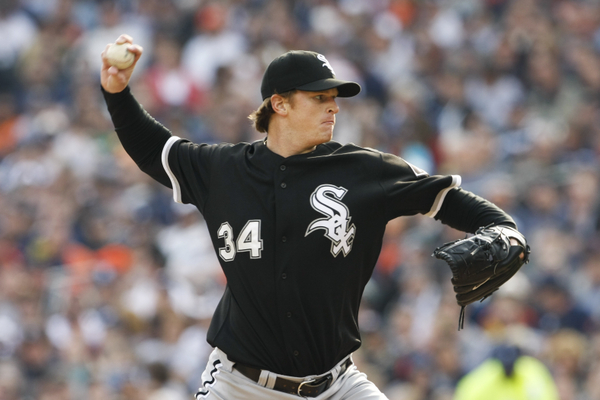
The last pitcher I'm thinking about is the least likely of the four, Gavin Floyd. I only selected him because of the General Manager of his team, the White Sox. Kenny Williams will trade anyone at anytime. He has emptied out his farm system in the past few years to get the players he feels the White Sox need to compete and succeed. I'm all in favor of trading prospects this offseason, but Kenny Williams takes it to the extreme.

One could make the argument that the Padres unexpectedly successful season is due to Kenny Williams. In July 2009, the Padres traded Jake Peavy to the White Sox for Clayton Richard and 3 other minor leaguers. Richard has been a dependable rotation staple for the Padres, while Peavy continued to be injury prone with a strange shoulder injury that has kept him out most of 2010. Trading Peavy's huge salary may have given the Padres the financial flexibility needed to keep Adrian Gonzalez, thus fueling this run for the postseason in 2010.

But getting back to Gavin Floyd....the White Sox are going to fall short again of the AL Central title this year. Perennially their payroll has hovered around the low $100M mark. Heading into 2011, the White Sox have salary committments of $75M already, with arb cases for Carlos Quentin and John Danks (plus whether or not to tender Bobby Jenks for maybe $10M) and a decision on free agent to be Paul Konerko. In short, the White Sox may be looking to retool and compete in 2011. Gavin Floyd's salary may help provide a little wiggle room for them.

Gavin Floyd, RHP -- age 28 in 2011 season
Contract details -- $5.0M in 2011, $7.0M in 2012, club option in 2013 for $9.5M

To date in 2010, Floyd has pitched 187 innings with a 7.20 K/9 rate, a 2.79 BB/9 rate, and has posted a 4.08 ERA and 3.48 FIP.

Floyd's arsenal includes a 92 mph fastball, 84 mph slider, 79 mph curve, and an 84 mph changeup. His slider has had the most positive results of runs saved per 100 pitches thrown.

As for the trade package, the White Sox in the draft are historically conservative. They favor the floor more than the ceiling so the Universal Trade Chip of Rudy Owens will work here. They are partial to toolsy outfielders, though, so Gorkys Hernandez may interest them. Diego Moreno with his live arm would fit nicely into their bullpen with Sergio Santos and Matt Thornton.

The Pirates need to upgrade the rotation and immediate help will not come from the farm before June 2011. Instead of hoping and wishing for the prospects to pan out, it's time for the Pirates to acquire known, successful commodities.