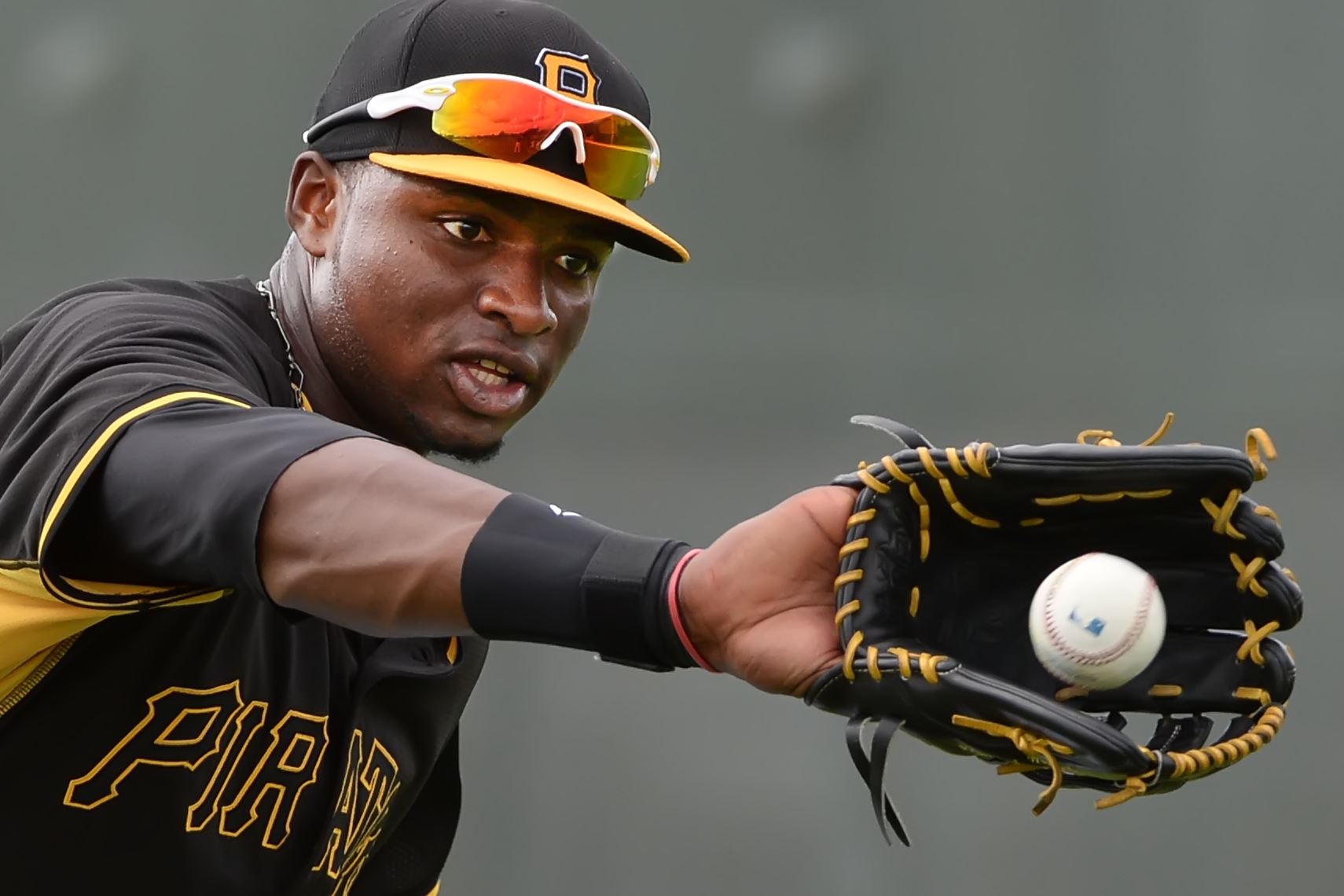
Showing posts with label Pirates. Show all posts
Friday, November 14, 2014
Pirate-Yankee Pipeline Still Flowing Strong
Sometimes you can tell that Fall is in the air. The crisp, biting wind that riffles through your hair. Ever-present pumpkins and hay bales. The smell of burning leaves in the air.
And the Pirates getting a catcher from the Yankees.
Two years ago, the Pirates signed Russell Martin away from the Yankees (let that sink in for a second) to a 2 year/$17M deal. Last year, the Pirates traded for Chris Stewart. And on Tuesday, the Pirates traded LHP Justin Wilson for Francisco Cervelli.
Not only were all three of those catchers Yankees, but they also grade out as excellent pitch framers. Cervelli's career has been forestalled by a series of odd injuries and a PED suspension, but in his limited action he appears to be a poor man's Russell Martin.
Cervelli has good power, especially for a catcher, and he can get on base. His OBP last year was .371 and stands at .348 for his career. For the projected estimate of $1.1M, Cervelli should be a bargain this year for the Pirates. As long as he can stay on the field, which has been his issue.
At first blush, this looks like the Pirates admitting that Russell Martin won't be coming back. The Pirates, perhaps to preserve positive public opinion, contend that they are still strongly pursuing Martin and Cervelli could be his backup. Presumably, Stewart would be non-tendered in that scenario. Otherwise, Cervelli and Stewart will be the tandem in 2015.
The only thing I know is that if he wants to save time, the equipment manager for the Pirates should start getting a jersey ready for J.R. Murphy in 2016.
Labels:
Dale Berra's Stash,
Francisco Cervelli,
Pirates
Saturday, October 4, 2014
Discussing Russell Martin
The Pirates' season ended earlier than I anticipated. I thought the Pirates could beat the Giants at home, but I didn't anticipate Bumgarner pitching an absolute masterpiece in the Wild Card.
So the Pirates are getting an earlier-than-hoped start to the offseason. For Neal Huntington, that means working on his to-do list on forming the 2015 roster. At the top of that list is signing Russell Martin.
Bob Nutting has given his blessing to expand the comfort zone to attempt to re-sign Martin. What that exact level is remains unknown. There are plenty of teams, including some big markets like both Chicago teams, the Blue Jays, and the Tigers that could be interested in him. But the Pirates have an X-factor -- Martin really likes playing here with these guys. That doesn't mean a lot, but it means something.
Here's my stance on how negotiations should go with Martin and the Pirates:
They should match any 3 year deal he gets. There's no average annual value under $20M that they can't swing.
They should consider matching any 4 year deal. I would go up to $14M/year for 4 years. This keeps him less than McCutchen's free agent year value in his contract.
They should walk away from any 5 year deal.
He's still going to 32 at the start of next year with over 1000 games behind the plate. No matter how great of an athlete you are (and he is), that's a lot of tread off the tires. I would like to think that Martin could be spelled by playing a few games at 3B or maybe even 1B, just to give his knees and mind a break.
In a perfect scenario, I would go 3 year/$38M with a club option for a 4th year. Now it's up to Martin to decide how much the clubhouse camaraderie is worth to him.
Labels:
Dale Berra's Stash,
Pirates,
Russell Martin
Friday, August 29, 2014
Why Re-Signing Russ Martin Is Important
Russ Martin has built a time machine. Or, to be trite, has discovered the Fountain of Youth. Either way, Martin is in the midst of his finest season since his 2007 season with the Dodgers. That year, Martin triple slashed .293/.374/.469 with 19 HR and 21 SB. As a catcher, mind you.
This year, he's put up a .295/.417/.416 line with 7 HR and 4 SB. But if you're a stathead (like me) then you may be interested to know that Russ's 2007 line resulted in a 122 Weighted Runs Created Plus (22% than league average), while his 2014 line is a 142 wRC+. How can that be? Because back in 2007, offense was greater around the league than it is today. So by this metric, this is Martin's career season.
Martin is a free agent after the season and it is imperative that the Pirates re-sign him. At the start of next season, Martin will be in his age-32 season and he will have 1000+ games as a catcher under his belt. He will start to wear down eventually, so the Pirates have to be cautious with the number of years.
2 years, I would be ecstatic, but Martin is looking for his final big payday. 3 years would be great. 4 years would make me nervous. 5 years -- good luck with your new team, Russ.
During his time with the Yankees and into his first year with the Pirates, Martin was trying to sell out for home run power. This year, he's made a conscious effort for contact and it has resulted in the fine line you see above. If Martin, over the course of a 3 year deal, could even bat .270/.350/400, that would be fantastic for a catcher.
Martin is a good athlete, too, so perhaps he could get a break from squatting behind the plate by playing 3B or 1B periodically. This would keep his bat (and his on-base prowess) in the lineup.
It's also important that the Pirates re-sign him as a show of good faith to the fans. The Pirates are in the middle of a contention window right now. Martin's on-base skills and pitch framing are things that are not sexy, but they age better than other skills like speed and power.
With record PNC attendances and the new national TV deals, there is plenty of money floating around Federal Street. Yes, the Pirates have a big arbitration class coming up, but even if you take their $23M of commitments and estimate $28M for arbitration, the Pirates should still be able to afford $12-13M/year for Martin.
Labels:
Dale Berra's Stash,
Pirates,
Russell Martin
Wednesday, July 30, 2014
Pirates Need For A Frontline Starter
Imagine it's October 1st and the Pirates are getting ready to play in the Wild Card Game. Who do you pick to pitch?
- Liriano, who has been inconsistent and ineffective for most of the season?
- Cole, who has been hurt and oddly non-dominant for most of the season?
- Morton, who is prone to one bad inning it seems every game?
- Locke? Volquez? Worley? Do you really trust any of these three in a one game playoff?
Then think of the Dodgers (Kershaw/Greinke), the Cardinals (Wainwright), the Nationals (Strasburg). These teams all have bonafide aces to throw out there, guys who are locks for 8 innings in a crucial game.
The Pirates need a name pitcher. I hope that Cole comes back from his rehab stint in early August and becomes that guy that we all hope he can be. If so, that would be a bonus. But right now, the Pirates need a horse.
Neal Huntington has been collecting prospects like they're Star Wars toys in their original packaging. When he breaks open one and deals them one year, then I'll know that the front office and ownership both believe the Pirates are a World Series contender. This year, if he deals Taillon, Glasnow, Kingham, Bell, or Meadows, that will signal to me that they are making a run and not worrying about the future as fastidiously.
There's a lot of big names out there, but most are out of the Pirates' price range for 2015 and beyond (Price, Lee, Hamels). I see two that are viable candidates -- Lester of the Red Sox and Kennedy of the Padres.
Lester is a low end #1/high end #2 level pitcher. He's got about $4.3M left this year and is then a free agent. The money this year shouldn't be a problem, since I calculate that the Pirates have $8M left from their original offseason spending pool when they were rumored to have $19M last offseason for free agents.
The Sox want one premium and one other top 10 prospect for Lester. I'm comfortable trading Bell and someone like RHP Adrian Sampson for Lester. The Sox had a great deal of interest in Bell during his draft year, but avoided him due to the infamous note his mother sent to all 30 teams asking them not to draft her son so he could go to University of Texas. Bell would be a loss, but that sting should just motivate the Pirates to win more.
Kennedy is a #2 pitcher and not as flashy of a name as Lester, but he would be an upgrade for this rotation. The Padres are said to be seeking an ML-ready starter for the rotation and a prospect for him. Since Vance Worley is basically found money for Huntington, why not include him? Worley has 3 more years of control and has revitalized his career. Imagine him in Petco. I would also use Universal Trade Chip Adrian Sampson in this scenario.
The Pirates have rebounded amazingly from their April malaise and positioned themselves well for the playoff run. It's time to solidify it.
Monday, June 30, 2014
Some Second Tier Thinking About Tony Watson
Tony Watson is making a mockery over keeping ERA's for the rest of the pitchers in the league. He's sporting a 0.96 ERA so far this year with 48 K's and just 10 BB in 37 innings. In a fair and just world, he would be going to the All-Star Game.
When he comes in to the game, you can exhale and go get a sandwich. This inning is on lockdown. So why is Watson not the closer, but the stress-inducing Mark Melancon is?
Is it because Melancon is a grizzled veteran and Watson is a young pup? No. Melancon and Watson are both 29. Melancon has one whole year more of experience in the majors than Watson. Is it because Melancon has superior stuff and Watson is getting by on luck? No. Watson is sporting a mid-90's fastball from the left side, along with a slider that is patently unfair to hitters. He toys with hitters by throwing a changeup, as well. Melancon is getting by on a 93 mph cutter that requires pinpoint location, or else hitters can sit on it and serve the pitch to right field.
After pondering this, I'm left with two choices:
1. Clint Hurdle is a stubborn idiot that can't change his thinking about Watson v. Melancon.
2. Something else.
The something else that I came up with is that Hurdle has been instructed from on high to keep Melancon in the closer role and allow him to rack up saves, while keeping Watson in the setup role. The reason? In arbitration, saves get you paid. Melancon has already set his salary base in arbitration at $2.6M. He has two years of team control left. Watson, on the other hand, is going to arb for the first time this year. A first year dominant closer with 30 saves and a minuscule ERA would get paid cash money, son.
Now instead of Watson going to arb and getting $2M as a new closer, he may make $1M as a great setup man. Is it dumb? Sure it is, but that's the outdated method of arbitration. Find a comparable player and go with it. With a handful of saves, Watson would be in the same bin as most other setup guys.
That $1M potential difference may seem petty, but that's the base future salaries are built off of. Now instead of a $2M/$4M/$6M path, Watson could be installed as the closer in 2015 on a $1M/$3M/$5M path. The Pirates, always on the hunt for a good deal, may have saved $3M on the process.
Unless you want to believe in choice #1.
Labels:
Dale Berra's Stash,
Pirates,
Tony Watson
Thursday, June 12, 2014
The Future is Now in the Outfield
Tuesday saw the long-anticipated arrival of RF Gregory Polanco. He was called up because of the emergency appendectomy of Neil Walker, which makes me wonder how much longer he would have to wait in AAA. No matter, he's here now and I can't envision the Pirates sending him back down (short of him struggling epically).
The Pirates now sport an OF that is the envy of all of baseball. All three of Marte/McCutchen/Polanco were not only top 50 prospects (and higher in the case of McCutchen and Polanco), but also capable of playing CF for nearly every team in baseball. Each of them have a combination of power and speed that makes scouts and fans alike drool.
Both Marte and McCutchen are under team control for many years to come, at far below market value rates. McCutchen is here until 2017 with a 2018 club option. Marte is here even longer through 2019, with two team options in 2020 and 2021. By virtue of his callup, Polanco is under team control through 2020, before any potential extension comes into play.
The things we build don't last forever, though. At some point, hopefully not for financial reasons, the Pirates may look to trade one of the triumvirate in order to strengthen another part of the team. The Pirates' cupboard is stocked in the minors with OF prospects, too. Austin Meadows, Harold Ramirez, and Josh Bell (although I feel he's a future 1B) are all progressing at various speeds through the minors and have great pedigrees.
For right now, enjoy watching these three together. I can't help but think that any short/medium term success the Pirates experience will be on the backs of their OF.
Saturday, June 7, 2014
How Much Would You Sign For?
The Pirates concluded their portion of the 2014 MLB Draft today when they made their selection in the 40th round. Counting two extra picks in the compensation rounds, the Pirates selected 42 high school and college kids. Not every kid will sign, based on a combination of their bonus demands and the Pirates' draft pool of $7.0M.
How much each kid requires to sign is a complicated calculus of figures, though, that is roughed out by the area scout who has spoken with him at some point. I'm wondering how much it would take for me to recommend my son sign, especially out of high school.
The Pirates selected a high school pitcher named Mitch Keller out of an Iowa high school in the 2nd round. The slot value for that pick is $886,800, as per figures obtained by Baseball America. Keller has been rated as a 2nd or 3rd round talent all spring, so he was picked right where he was rated. He does have a college commitment to North Carolina, so it would appear that he may take a little over slot to sign and be difficult to get under contract.
But then I found an article with an interview from last month that Keller gave to his local newspaper. In it, he tells the story of how his older brother, Jon, gave him some advice from his own situation. The cautionary tale tells how Jon was drafted in 2010 by the Mariners and turned down a high six figure bonus to go to college. In college, Jon developed arm troubles and was then drafted by the Orioles in 2013 and received only $100,000, a much lower figure than what he turned down in 2010.
His brother has told him that if the money is life-changing he should take it, because you never know what may happen in the future. The $100,000 that Jon received sounds like a lot, but after 5% off the top for agent fees and then roughly 35% of taxes, Jon Keller only cleared approximately $60,000. Good money, but not life-changing.
If Mitch Keller were to sign for (rounding up) $900,000, he could clear $550,000 probably. That's not money to live off of the rest of your life, but that's a real nice start to a nest egg. He wouldn't have to worry about a ton of stuff if his career flamed out early.
For me, if my son could sign for $500,000, that would be a net of about $300,000. That would enable him to put a down payment on a nice house and get a nice car after his baseball career was over. He would have to work, but some of the hassles of life would be reduced for him. That amount is the slot value at the end of the 3rd round in this year's draft.
College is always there; it's not going anywhere. Many teams will sweeten the deal for high school picks by promising four years of tuition to a college, as well. At that point, it's almost a no-brainer. Allow your son to pursue his baseball dream, then he can go back to college after it's over on someone else's dime.
I hope the Pirates can sign as many of their high school picks as possible, but they won't get them all. I just hope that some of them don't sign just because it's not for every last dollar they think their son deserves. Sometimes it's worth getting the bird in hand, instead of waiting for two in the bush.
Saturday, May 31, 2014
June Schedule Lightens Up for the Pirates
Perhaps the Pirates are just trying to add some degree of difficulty to their year. Maybe working with the third lowest payroll in Major League Baseball is not enough of a challenge for them. The Pirates dug themselves a hole in April, going 9-16, to enter May with a 10-16 record (March opening days are weird). They've righted the ship, so to speak, in May with a 15-13 record to give a glimmer of hope that they can still make a run.
Their schedule heretofore has been brutal. Of the 54 games they have played, only 20 have been against teams with losing records. The combined record of the other teams they've played in those 34 games is 208-159, good for a .567 winning percentage. In those games, the Pirates have gone just 15-19, with most of the damage due to the old nemesis of the Milwaukee Brewers (2-8). The Pirates have fared better against the sub .500 teams (Cubs, Reds, Mets, Nationals), going 10-10 so far.
The good news is that better days lie ahead in June. Hopefully, unlike their namesake pirates of the seas, the call of better days does not cause a shipwreck against craggy rocks. In June, the Pirates play 27 games. Of those 27 games, 20 are against teams with a losing record currently. The seven games against winning teams are: the final game against the Dodgers in the current series, 3 on the road at Miami, and 3 at home against Milwaukee. As the records stand right now, the Pirates wouldn't play a winning team in the month of June after the 15th.
The split between home and road games is fairly even for the Pirates -- 13 on the road and 14 at home. So far this year, the Pirates have been abysmal on the road, so hopefully the lesser competition will start to build their confidence in that regard.
June 1st is far too early to start worrying about the playoffs. July is when a team will typically decide whether to fish or cut bait, ahead of the July 31st trade deadline, but you also can't allow yourself to get too far under water. The first thing the Pirates need to do is get back to .500; no team makes the playoffs under .500. In recent years, 89 wins has been the magic number to secure a playoff spot. The Pirates would have to go on a tear to achieve that, but maybe they won't have to this year.
If you set aside the current division leaders of Milwaukee, Atlanta, and San Francisco, there are no other teams really putting up strong records yet. The Cardinals are 3 games over .500. The Marlins, who are a prime candidate to swoon in the summer, are just 2 games over. The Dodgers are spinning their wheels and just 2 games over. The Rockies are already scheduling their return trip to Earth and 2 games above the break-even mark.
It's looking to me like maybe 86 wins could be enough to sneak into the 2nd Wild Card slot this year. For the Pirates to do that, they would have to go 61-47 in their final 108 games (.564 winning percentage), which is essentially the Atlanta Braves current winning percentage. Last year, when they went 94-68, the Pirates had a .580 winning percentage, so it's definitely in their wheelhouse to pull off.
So do not abandon all hope ye who enter. At least until July 1st. Aaargh.
Wednesday, May 7, 2014
Here's Why Polanco is Not in Pittsburgh Yet
RF Travis Snider is hitting .211 with a 623 OPS (on-base plus slugging percentage).
Platoon mate RF Jose Tabata is hitting .247 with a 605 OPS. Every other ball seems to be a grounder to shortstop.
In Triple A Indianapolis, uber-prospect RF Gregory Polanco is hitting .395 with a 1057 OPS. He has power (4 HR) and speed (7 SB), two things that Tabata is not showing and one thing that Snider (the speed) does not have. By all accounts, he would be an upgrade over these two. The added bonus is that he has no platoon splits (979 OPS v. LHP, 1092 OPS v. RHP). So why isn't he up in Pittsburgh yet?
Let's take a look at some of the reasons, of varying degrees of legitimacy, why Polanco is not in Pittsburgh:
A spot would need to be cleared on the 25-man roster. I find it hard to believe the Pirates would carry five outfielders, especially without the need for a platoon partner for Polanco, so that means that one of either Tabata or Snider would have to go. I know what most of you are saying -- "OK. Don't let the door hit your rear end on the way out," but it's not that easy. The Pirates do not have options remaining on either Tabata or Snider, so they would have to Designate For Assignment (DFA) one of them. If one of them were claimed during this 10-day waiver period, the Pirates would lose that player for nothing.
To the Pirates, that is a terrible offense. They like to squeeze every last bit of value out of a player, so you can be assured that Neal Huntington is feverishly working the phones trying to trade one of them, even if it is for a low-level reliever. A trade could be worked out during the 10-day DFA window, but those are not as common. Because of Jose Tabata's long-term guaranteed contract ($3.1M in 2014, $4.1M in 2015, $4.6M in 2016) he seems very unlikely to be traded unless the Pirates ate a bunch of that money. That means Snider and his $1.2M in 2014 is the better candidate. Snider has two more years of control after this, but a team could non-tender him at the end of 2014 and not cost themselves any additional money. There are plenty of teams out there with awful outfielders that might be interested in a flyer on Snider or Tabata.
He hasn't experienced any adversity yet. This one always irks me, but the reasoning is that the Pirates need to see how a player responds to a rough patch. They would rather see him work through a 1 for 32 stretch in Indy than in Pittsburgh against the best pitchers in the world. This answer is part of the mythological "player checklist" that every team says a player has to complete before getting promoted.
The Pirates want to avoid the Super 2 Deadline. And now we come to our portion of the program that really matters. Essentially, if a player gets into the top 17% of service time for players in his service time class between 2 years and 3 years of service, he gets to go to arbitration four times instead of three. This can mean an additional cost of $10-$15M of salary for a team over that time period.
This is a real, tangible thing for a team. Not just the Pirates, either. Many teams are wary of their top prospects getting to Super 2 status. The rough threshold to promote is with 130 days left in the season (this year there are 181 days). That outer threshold is around May 21st. However, most years the threshold falls into the 118-125 range, so allow for a couple of extra weeks to be safe. That puts the date around June 3rd.
It will be interesting to see how many top prospects around the league magically "complete their checklists" and are ready to be promoted in early to mid-June. It's amazing how many of the top guys are always ready around the same time of the year.
When Polanco does get promoted, he can't be expected to be a miracle worker or savior. Just because he's ripping the cover off the ball in Triple A does not mean that will translate to the Majors. The class of competition is dramatically better. I do think he will be an improvement over what the Pirates have in RF now, but where I expect the greatest improvement to occur is in the leadoff spot.
Polanco has greater plate discipline than Starling Marte or any of the other players the Pirates have penciled in to the spot so far this year. Right now, the aggregate leadoff hitters are triple slashing .222 BA/.290 OBP/.310 SLG (600 OPS) with 1 HR and 7 SB's. Polanco, even if he struggles out of the gate, should be able to exceed that very low bar that has been set.
Gregory Polanco will get here, probably within the next month, so be patient. Once he gets here, he's not going anywhere for a long time.
Labels:
Dale Berra's Stash,
Gregory Polanco,
Pirates
Sunday, April 6, 2014
Gerrit Cole and The Potential, Never-Going-To-Happen Extension
With Starling Marte's recent extension, talk turned to who the Pirates could lock up next in an effort to cost control their core players. Gerrit Cole is the next logical candidate, but since Cole's agent Scott Boras is a well-known proponent of getting his star players to free agency as quickly as possible, it's very unlikely.
If Cole were to sign his extension after the 2014 season, he would have 1 year and 111 days of service time accrued. This should put him safely outside of the dreaded Super 2 threshold, meaning the Pirates would only have to go to arbitration with him three times instead of four. After this year, the Pirates can pay Cole approximately the major league minimum ($500,000) for 2015 and 2016. Then from 2017-2019, he would be arbitration-eligible. So a potential 6 year deal would buy out all five years of remaining team control, plus one free agent year.
To re-iterate -- this is very unlikely to happen because of the presence of Scott Boras. But let's continue along.
Using the Extension Tracker on MLB Trade Rumors, I filtered the results for starting pitcher extensions between 1 and 2 years of service time. Since 2008, eleven pitchers have signed extensions with this level of service time. Of those pitchers, though, only two are in the same neighborhood of Cole in terms of minor league pedigree (how much hype was given) and ceiling (top of rotation pitcher). Those two pitchers are the aforementioned Julio Teheran (6 yr/$32.4M, with 1 option year) and Madison Bumgarner (5 yr/$35M, with 2 option years). It should also be noted that both of these pitchers are clients of the Relativity Baseball agency.
Both Teheran and Bumgarner are low-end #1's or high-end #2 pitchers, in my opinion, while I think Cole could be a pure #1 ace. Let's look at the year-by-year breakdown for each pitcher:
Teheran
2014 -- $1M signing bonus, $800K salary
2015 -- $1M
2016 -- $3.3M
2017 -- $6.3M
2018 -- $8M
2019 -- $11M
2020 -- $12M option with a $1M buyout
Bumgarner
2013 -- $1M signing bonus, $750K
2014 -- $3.75M
2015 -- $6.75M
2016 -- $9.75M
2017 -- $11.5M
2018 -- $12M club option with a $1.5M buyout
2019 -- $12M club option with same $1.5M buyout
If you compare both of them, the year-to-year salaries (at the same point in their service time cycles) are very similar. Their "platform season" performance prior to getting their contracts are very similar, too. In Julio Teheran's first full year in 2013, he put up a 3.20 ERA/3.69 FIP in 185 innings with a 8.24 K/9 and 2.18 BB/9. In Madison Bumgarner's first full year in 2011, he put up a 2.77 ERA/3.05 FIP in 204 innings, with an 8.4 K/9 and 2.02 BB/9. The 2014 season will be Cole's first full season. In 2013, his 3.22 ERA/2.91 FIP, 7.67 K/9, 2.15 BB/9 rates all show that he is primed for a breakout full season.
Although I've mentioned twice now that an extension is not likely with Scott Boras, it's not unprecedented. Since 2008, Boras has negotiated multi-year extensions for eight players. However, of those eight players only seven bought out or had an option on any free agent years. Prince Fielder merely cost-controlled two arbitration-eligible years. It's also worth noting that only one those players, Carlos Gonzalez of the Rockies, signed a deal before he reached arbitration. He had just over two years of service time when his deal was signed. Additionally, only one of these players, Jered Weaver of the Angels, is a starting pitcher.
Even though an extension is highly unlikely, let's assume Scott Boras is in a generous mood with the Pirates. He'll want Gerrit Cole's contract to be precedent-setting, so he'll want to exceed the Teheran/Bumgarner deals. Here's a potential framework:
2015 -- $2M signing bonus with a $1M salary
2016 -- $2M salary
2017 -- $4.5M
2018 -- $7.5M
2019 -- $10.5M
2020 -- $13M
2021 -- $15M option with a $2M buyout
That totals up to a 6 year/$42.5M deal with an additional option year worth $15M potentially. Except that it most likely won't happen because (all together now) Gerrit Cole has Scott Boras as an agent.
Monday, March 31, 2014
2014 Season Prediction
All right, let's do it. This is a much more pleasant exercise than in previous years, because the Pirates actually...won. It's a very weird feeling predicting that the Pirates are playoff contenders in 2014. Is this the new reality or am I still being oddly optimistic?
Mark me down for 88 wins and the Pirates claiming a wild card spot in the NL. I think the same seven teams that were in playoff contention (Cards, Pirates, Reds, Dodgers, Diamondbacks, Nationals, Braves) will be the same teams in contention this year. Perhaps if the Giants' pitching staff rebounds they can get in the mix.
I think Travis Snider will have a nice rebound year now that his big toe injury has finally been resolved. It won't be enough to hold off mega-prospect Gregory Polanco from coming up in mid-June and claiming RF, though. Polanco will get some fine-tuning and avoid the Super 2 deadline so that the Pirates only have to go to arbitration with him three times instead of four.
Jameson Taillon had a little setback at the end of Spring Training with his elbow, so they're going to rest him and hope the elbow inflammation dies down. Right now they're not seeing any tears in the ligament, so that's good news. Hopefully it won't affect his mid-June arrival time, as he should require less fine-tuning in AAA.
It's almost impossible to think McCutchen can exceed, or even replicate, his 2013 MVP season. I would be satisfied with a season that's 85% of his 2013 season. I would like to see Marte improve on his BB rate and keep decreasing his K rate, while increasing his HR's and maintaining his SB total. Ideally, once Polanco comes up, Polanco will leadoff and Marte will drop down to the 5th or 6th spot.
Alvarez?
I don't know...I'm just getting such a Mark Reynolds vibe off of him, so I'm not going to be surprised by another .230 BA, with 35 HR's and 200 K's.
Quasi-bold prediction? I think Gerrit Cole will garner some NL Cy Young votes this year. Not really a contender, unless Kershaw gets hurt, but some down ballot votes.
I also don't think the 1B the Pirates will end the season with is on the roster yet. There should be adequate money left in the budget for a mid-season trade acquisition, considering they had $19M to spend in the offseason and only spent $7M of it on Volquez (dumpster fire, will be out of the rotation by July) and Barmes.
So finally, here's my guess on the NL Central Standings:
Cardinals -- 96 wins
Pirates -- 88 wins
Reds -- 83 wins
Brewers -- 75 wins
Cubs -- 74 wins
Tuesday, March 18, 2014
Don't Extend Pedro Alvarez, Pirates
Recently, the Atlanta Braves extended their 1B Freddie Freeman with an 8 year/$135M contract. Freeman was just entering his first arbitration year, so this contract buys out those first three years plus five free agent years. The cost breakdown per year is:
2014 – $5.125M (w/ $2.875M signing bonus)
2015 – $8.5M
2016 – $12.5M
2017 – $20.5M
2018 and 2019 – $21M
2020 and 2021 – $22M
He’ll finish this contract up in his age-31 season and be ready, injuries aside, to look for another 5-6 year deal probably.
Pedro Alvarez is entering his first arbitration-eligible season and negotiated a contract for $4.25M for the 2014 season. At first blush, he and Freeman seem to be on the same salary track, so one would think that the Pirates should follow suit and think of extending their power-hitting third baseman.
But they shouldn’t. Because Pedro Alvarez isn’t that great of an offensive player.
In fact, the Pirates should stick with Alvarez in 2014 and 2015, then re-evaluate the texture of the team. If they are a title contender for 2016, then they should keep Alvarez and become comfortable with letting him walk after the 2016 season for draft compensation. If they don’t think they’re a contender, then the Pirates should trade him after 2015 for a package of prospects to reload on the fly.
The thought of not having Alvarez around, a season after he hit 36 home runs, causes some fans to have panic attacks and rail against the Pirates’ for being cheap by not extending him. Rather, it’s my contention that the Pirates would be smart to just play out the string with Alvarez and let him walk away as a free agent or trade him with one year of control left.
It’s the Linus Blanket Syndrome. The fear of losing a security blanket, in this case all the DINGERZ that Alvarez hits, causes people to worry. But aside from home-runs, Alvarez does not contribute much to the offense.
Let’s compare Alvarez to Freeman:
| 2013 Stats | Alvarez | Freeman |
| OPS | 770 | 897 |
| BB % | 7.8% | 10.5% |
| K % | 30.3% | 19.2% |
| WAR | 3.1 | 4.8 |
| wRC+ | 111 | 150 |
wRC+ stands for Weighted Runs Created over Average. What this means is that Alvarez created 11% more offense than an average player, while Freeman created 50% more offense than an average player.
So by raw numbers, it’s pretty obvious that Alvarez would not be worth Freeman’s contract, even though Alvarez hit 36 DINGERZ to Freeman’s 23. There are other facets of the offensive game that Alvarez does not contribute to and, in fact, hinders thanks to his high strikeout rate.
The strange part about the Freeman deal is that I don’t think he’s worth it. Up until the 2013 season, Freeman was just slightly above-average when it came to offense for a 1B. His excellent 2013 season was based on a very high .371 BABIP (Batting Average on Balls in Play), where the average player is typically .300 to .310 and Freeman was a .320 career BABIP coming into 2013. So there is some regression due to happen for Freeman, most likely, in 2014.
Also, the 2014 season will be Alvarez’s age-27 season. The Pirates potentially control him through his age-29 season, so they may be seeing the best years he has to offer anyway, as players with 30% strikeout rates and low batting averages do not age well (Adam Dunn is Example A).
The end of the world will not occur if El Toro is not extended or if he’s allowed to leave in a few years. Actually, it would be good business sense to not be weighted down by a potential albatross contract.
Labels:
Dale Berra's Stash,
Pedro Alvarez,
Pirates
Monday, March 10, 2014
Time for Snider to go for it
There are many things that Travis Snider can do. There are many things that people think Travis Snider can do. What Travis Snider has done is somewhere in the middle.
Look at Snider's minor league numbers and his stocky profile and you think he's a guy capable of hitting 25 home runs every year. Just last year he started off hot in April, hitting .300 with an 11.8% BB rate and 7 doubles in just 68 plate appearances. Not a ton of power, but doubles are good and walks are great, especially out of your 6/7th place hitter.
But then his toe injury flared up and Snider just fell off the cliff after that. After May 1st, he hit .182 and was a complete afterthought for Clint Hurdle, especially once Marlon Byrd rolled into town. He only had 20 plate appearances in September and October combined.
Now here we are in 2014 and the Pirates have one opening in their outfield in RF. It appears as if Tabata and Snider can job-share (maybe not a straight platoon) that spot in 2014. But on the horizon looms mega-prospect Gregory Polanco. Polanco is scheduled to get a tune-up in Triple A Indy, then wait out the Super 2 arbitration deadline, with a scheduled arrival in mid-June if everything goes well.
Snider and Tabata can delay his arrival if they come out en fuego and force GM Neal Huntington to keep Polanco on the farm. Polanco is clearly the future, as the Pirates are practically salivating over the possibility of an OF of Marte, McCutchen, and Polanco with that power-speed combo in each of them.
But Snider can help himself be more marketable in a trade to a decent destination by performing at a decent level. He can easily stay around for 2014 as the 5th OF and spot starter, but it's hard to see him being here beyond this year, as 2015 is his 2nd arb-eligible season. Snider could be packaged with something else for a 1B, if that position continues to be an issue at the trade deadline in 2014.
In short, a fully healthy Snider can be an asset for the Pirates. Both on the field and in the trade market.
Sunday, January 5, 2014
The 1B Situation for the Pirates
We’ve flipped the calendar over to 2014 and the Pirates seemingly have still not resolved their 1B situation. They were in on James Loney, but ultimately he went back to the Rays. Yes, they have picked up Chris McGuiness (from TEX) and Travis Ishikawa (minor league FA), but I would consider them Plan C and Plan D, respectively. Who’s still out there to obtain that would be of an upgrade to the current platoon of Andrew Lambo (vs. RHP) and Gaby Sanchez (vs. LHP)?
Justin Smoak (SEA)
Seattle has gone on a binge of picking up potential 1B this offseason by trading for Logan Morrison and signing Corey Hart as a free agent. Both of those guys also play the OF, in theory, but seem more aligned to play 1B.
Smoak has been very underwhelming since being drafted 11th overall in 2008 (same draft as Pedro Alvarez). His career line of .227 AVG/.314 OBP/.386 SLG (700 OPS) is only slightly worse than his “career year” line in 2013 of .238/.334/.412 (746 OPS). So why do I consider him the top choice?
Smoak is a switch hitter who should really stop switch hitting. His splits from the left side versus RHP in 2013 were very good (.260/.361/.477, 839 OPS with 18 of his 20 HR), while his splits from the right side versus LHP were soul-stealing (.192/.274/.274, 548 OPS, 2 HR). Also something to consider is that his defensive metrics grade out as average, which this front office values.
If Smoak were put in a strict platoon with lefty-killer Gaby Sanchez, it could be a very productive 1B situation.
Adam Lind (TOR)
2013 was a resurgent year for Lind, who started off strong in Toronto, had a monstrous 2009 which led to a modest 4 year/$18M extension, then has been pretty below-average since. His 2012 campaign was particularly ugly (.255/.314/.414, 728 OPS) and saw him back in AAA for a stretch. It seemed like the Blue Jays would play out his 2013, then decline his option years in the contract for 2014-16.
But then he had a nice campaign of .288/.357/.497 (854 OPS) with 23 HR and the Blue Jays picked up his $7M option for 2014. This gives them the chance to keep him or trade him. The Pirates and Blue Jays already have had discussions, with the rumor being the Blue Jays asked for Neil Walker. Neal Huntington, in dealing with a polite Canadian, turned him down. Perhaps they discussed how the Maple Leafs were doing before the phones were hung up, not sure.
Lind, as a LHB, is another guy that would need to be platooned as his splits were also atrocious against LHP (.208/.240/.333, 573 OPS), but exquisite versus RHP (.309/.385/.539, 924 OPS). On the basis of bat alone, Lind would be my top choice, but I have him at the second spot because he is awful in the field by all defensive metrics. His best position is pretty much designated hitter, but I would be willing to accept some gaffes if he could produce that line with Sanchez covering him against LHP.
Ike Davis (NYM)
Welcome to the land of broken toys. The Mets have been trying to push Davis around the whole league this offseason, because it just isn’t working out in New York for him. They’ve discussed him with the Brewers (wanting Tyler Thornburg), the Orioles (wanting Eduardo Rodriguez), and the Pirates (wanting Nick Kingham). All of those deals, correctly, were turned down for being too much for a guy the Mets were on the verge of non-tendering in November.
Davis is a guy who should be better, but is stuck in his own head. Whether it’s the coaching or the pressure of New York, I’m not sure, but his pedigree (18th overall, 2008) doesn’t lend itself to hitting .205/.326/.344 (670 OPS) with only 9 HR and a 26.8% strikeout rate.
Davis is another guy that should never see a LHP, as his line in 2013 (.145/.203/.203, 406 OPS) would attest. He was somewhat better against RHP (.222/.356/.371, 727 OPS), but he’s not someone I would give up a decent prospect for in the hopes of a change of scenery doing him any good. It would have to be for a lower tier starting pitcher that would project as a back-end starter or a reliever in the minors.
Mitch Moreland (TEX)
Moreland is the definition of a “blah” player to me. Since trading for Prince Fielder, speculation has been that Moreland is on his way out of town, but he could still split the 1B/DH position with Fielder.
In 2013, Moreland hit .232/.299/.437 (736 OPS) with 23 HR. And, in a surprise with the tenor of the rest of this article, did not have very pronounced splits. He was mediocre against both sides of the mound as a left-handed batter. His splits versus LHP were .241/.297/.404 (701 OPS) with 3 HR, while against RHP his line was .227/.300/.452 (752 OPS) with the other 20 HR. Clearly, his power comes against RHP, but it’s still not that impressive.
Of the four of the players, his defensive metrics grade out the highest at 1B, but he’s just not someone to get too excited about.
There is still time before spring training starts, so there is time for the Pirates to upgrade the 1B position. But here’s something else to consider: In 2013, the Pirates won 94 games in the regular season with 1B being decidedly blah. The person who has to replace Garrett Jones’ production in the 1B platoon only has to beat his .233/.289/.419 (708 OPS) with 15 HR. It’s not that big of a bar to leap over.
Wednesday, November 13, 2013
Seriously, What Happened to Neil Walker's Switch Hitting Ability?
Neil Walker was a hot mess this year as a right-handed batter against lefties. It's to the point where there is legitimate talk about putting him a platoon situation. Good news is that he is still fantastic against RHP's, of which there are significantly more pitchers.
But it wasn't always this way. What it has been is a long, steep decline. Check out his splits for each of his full seasons (2010 to 2013).
2010
v. RHP -- .298/.353/.465 (818 OPS), 123 wRC+
v. LHP -- .295/.344/.464 (809 OPS), 118 wRC+
As a refresher, wRC+ is weighted Runs Created above average. 100 is the base level, so Walker was 23% better than average against RHP and 18% better than average against LHP. There is virtually no split at all here. It's pretty much the perfect example of a switch hitter.
2011
v. RHP -- .277/.340/.434 (773 OPS), 114 wRC+
v. LHP -- .269/.322/.350 (672 OPS), 86 wRC+
OK, starting to go downhill, but it's still manageable. The disconcerting part is that his isolated power dropped to .081 versus LHP. If Walker could hold the line here, it would be acceptable, but not preferred.
2012
v. RHP -- .291/.352/.473 (825 OPS), 126 wRC+
v. LHP -- .246/.314/.288 (602 OPS), 69 wRC+
Well, now the wheels are off the wagon completely. He's not even hitting for an empty average, as his .246 is poor. Even worse is his isolated power is now at .052, which is Juan Pierre-esque. And his weighted Runs Created continues to drop like an anvil in a lake.
2013
v. RHP -- .256/.350/.455 (805 OPS), 127 wRC+
v. LHP -- .225/.281/.238 (519 OPS), 48 wRC+
I mean...c'mon now, Neil. There's no way to defend any part of this horrible line. A .013 isolated power? Neil hit 1 double, 0 triples, and 0 home runs this year. And he's 52% worse than average against lefties.
Just take a second and look at the steep and consistent decline in those numbers from year-to-year. That's jarring. It's at the point where someone has to say to him "Stop switch hitting, Neil."
It literally can not be worse if he batted full time as a lefty.
I am a big advocate of giving Neil Walker a moderate extension. I'm proposing something along the lines of 4 years/$30M. The contract would buy out the three remaining arbitration years (Walker is a Super 2) and his first free agent year. That would take Walker through his age-31 season. By that time, Alen Hanson would hopefully be able to take over at 2B. My Hanson estimate is that he would be ready in mid-2015, so Hanson could apprentice in the middle infield at either SS or backup both SS and 2B.
In the meantime, for the love of baseball, stop switch hitting Neil.
Where will all the new TV money go -- nationally and the Pirates?
For the 2014 season, new national TV contracts kick in from ESPN, TBS, and Fox. All together, each team's share will go from $23M to the range of $50M, per team, per year. That's an increase of $27M.
With all this extra money being injected into the game, it's only logical to think that it's going to get reflected in free agents this offseason. After all, min-scale salaries are governed by the Collective Bargaining Agreement and will still hover around $500,000. Arbitration is heavily based off of counting stats and previous contracts, so any change in salaries there will be gradual.
This is the season of crazy contract demands, such as Robinson Cano wanting 10yr/$305M and Ervin Santana and his $100M contract demands. Both of those guys are probably going to get 60% of those demands in the end. Cano's case is interesting because his market is so, so limited, especially when he comes out with that number. There are maybe 5 teams that can afford him -- Yankees, Dodgers, Mets, Angels, and Red Sox. The Mets are still building a contender and have said they don't want to spend on Cano. The Red Sox have Pedroia. The Angels have Howie Kendrick (who they're looking to move to re-allocate payroll to pitching) and a host of bad contracts already. The Dodgers just signed a Cuban ex-pat to play 2B.
So that leaves the Yankees, realistically. And they aren't going to bid against themselves, one would think.
Players like Shin-soo Choo and Jacoby Ellsbury will be in demand and they'll definitely get overpaid by someone, but it's hard to see it being a "good Lord" overpay. I suppose it's possible that the middle tier of free agents, like a Scott Feldman/Phil Hughes type, will be the ones to benefit the most from the influx of TV money. I can see some pitching needy team like the Twins or Rockies dropping a ton of shantovoes on them.
The Pirates are an interesting case, as they have already said that dedicating the $14.1M qualifying offer to A.J. Burnett would occupy too much of their offseason budget. I've estimated that including arbitration cases (and non-tendering Garrett Jones) and pre-existing salary commitments the Pirates payroll stands at $60M going into 2014. It was $65M on opening day 2013, plus they had a strong attendance season, and new TV revenue.
You would think that $75 to $80M would be a realistic payroll figure. Some teams may be allocating a portion of that new TV money to paying down heavily leveraged debt. That's their prerogative to do so. But many teams are going to put it towards payroll, so you don't want to be left behind, either.
Saturday, October 19, 2013
Pirates Pick Up A New Appalachian League Affiliate -- It's Appy Hour!
This past week, the Pirates announced that they became affiliated with an Appalachian League team in Bristol, Virginia. Previously, Bristol was affiliated with the Chicago White Sox and were known as the creatively named Bristol White Sox. So a name change is in order.
The Appalachian League is what's known as an Advanced Rookie league. It's between the Gulf Coast League and the New York Penn League in terms of short-season pecking order.
It's a great addition to the roster of minor league teams and gives the Pirates 7 affiliates. The Appalachian League will be good for an advanced high school draftee (like Austin Meadows this year) or an international player that may not be ready for the college-heavy New York Penn League (like Edwin Espinal this year).
Having an extra affiliate will help spread out developmental innings for all the pitchers in the Pirates' system, especially since they can't help themselves and draft tons of pitching each year. It will also help hedge a bet in case the "Morgantown affiliate that we're building a new stadium for but won't acknowledge it to anyone yet" stadium has a delay in construction somewhere. The Pirates' Jamestown affiliate has the 2014 season left in the original two-deal affiliation deal. With the Morgantown stadium expected to be open for the start of the 2015 season in June, it should all fall together nicely. But just in case, the Pirates can go without a NYPL team for one season and funnel everyone to Bristol or GCL.
It's a good developmental move. I'm curious how long the Pirates will maintain 7 affiliates, though. The Appy League is more of a luxury than a necessity.
Monday, October 14, 2013
Gerrit Cole and the Pirates' History of Pitchers
For all of the Pirates legendary players, the vast majority of the truly great ones have been hitters. The Pirates have not had many great long-term pitchers, especially since racial integration started to occur in the late 1940’s.
If you look at Baseball Reference’s Pirate Pitching Leaders page, you’ll see it is dominated by pitchers that played in the late 1800’s and early 1900’s. This is to be expected for the traditional “counting stats” such as innings pitched, wins, and strikeouts. It’s pretty easy to rack up the innings total and wins like Wilbur Cooper when you’re regularly pitching 285-325 innings per year. Those totals will just never be seen on a regular basis again.
I wondered if the Pirates were just victims of their own long standing history, as it related to the leaderboards being dominated by old-timey pitchers. I went on the Cincinnati Reds’ Pitching Leader page and saw plenty of modern-day pitchers like Jose Rijo (4th in K’s), Bronson Arroyo (7th in K’s, 9th in games started), Mario Soto (2nd in K’s), and Aaron Harang (6th in K’s).
But even within the last 50 years, there just have not been many truly great Pirate pitchers. Bob Friend leads them in both innings pitched and strikeouts, but that’s more to the fact of his longevity, as he was a Pirate for 15 seasons and finished with a 191-218 record with the club. The strikeout was de-emphasized in that era, as well, which is why he has “only” 1,682 strikeouts in 3,480 innings pitched as a Pirate (4.35 K/9, which you couldn’t last in today’s game with that ratio).
Vern Law is perhaps the iconic Pittsburgh Pirate pitcher of the past 50 years, as he pitched all 16 seasons with Pittsburgh and finished with a 162-147 record. He also appears throughout various Top 10 lists for Pirate pitchers (4th in IP, 5th in K’s, 6th in wins).
Bob Veale was like a less temperamental Oliver Perez, as he racked up some mammoth strikeout numbers, as well as large walk numbers, during his 11 seasons with the Pirates. Veale finished with a 116-91 record and is 2nd in strikeouts with 1,652.
Since the advent of free agency in 1975, the Pirates have had even fewer all-time great pitchers in their history. Perhaps the two best pitchers during this era have been John Candelaria and Doug Drabek. There have been plenty of good to very good level pitchers, plus some fantastic single seasons (Perez in 2004 and Liriano in 2013), but no real iconic careers aside from those two.
Candelaria came up in 1975 as a 21-year old rookie and pitched 12 seasons for the Pirates. He finished with a 124-87 record as a Pirate and was a key member of their glory years in the ‘70’s. His 1977 season (20-5, 2.34 ERA, 5th place in Cy Young vote) was his masterpiece.
Drabek only lasted his 6+ seasons that the Pirates controlled his rights, after he came over in a trade with the Yankees, but he put his mark on the rotation during the 1990-92 run of division titles. As a Pirate, he finished with a 92-62 record, 3.02 ERA, 1.15 WHIP (8th all-time for Pirates), and one NL Cy Young.
All of this is saying that the bar for Gerrit Cole to reach all-time Pirate greatness is pretty low. He has all the tools and arsenal of pitches to enter into this relatively small modern pantheon. After this season, he is under control with the Pirates for 6 more full seasons (2014-2019), until uber-agent Scott Boras whisks him away to free agency, where the Pirates may lose out on his services.
Cole is also entering a renaissance period for the Pirates, as it appears as if this is just the start of a prolonged window of contention. At the very least, it should be a period of “not sucking”, which will afford Cole the opportunity to accrue bulk counting stats like wins, innings, and strikeouts.
While I would love to have Cole here for his entire career like Vern Law, it’s more realistic to expect him to have the Doug Drabek style of 6+ years instead. If he can replicate Drabek’s career, but with more strikeouts, that would be quite an achievement. It would probably allow him to be talked about in the same conversation as some of these pitchers mentioned in the article as All Time Great Pirate Pitchers.
Labels:
Dale Berra's Stash,
Gerrit Cole,
Pirates
Subscribe to:
Posts (Atom)

.jpg)